



Kenya’s New Police Uniform Unveiled as KSh2.8 Billion Tender Controversy Sparks Questions
Kenya’s new General Duty police uniform has sparked public debate following its unveiling on August 28, 2026, with the light-blue shirt and navy-blue trousers replacing the previous Persian-blue design. The controversy centres on reports of a KSh2.8 billion tender, with early reports linking the deal to Nalitex Limited and raising questions about alleged political connections. However, the National Police Service (NPS) has strongly denied those claims, stating that Nalitex neither participated in the procurement nor received the contract, purchase order or payment. NPS says the contract to manufacture and stitch the new uniforms was instead awarded to Bedi Investments Limited after a procurement process involving several Kenyan textile manufacturers.
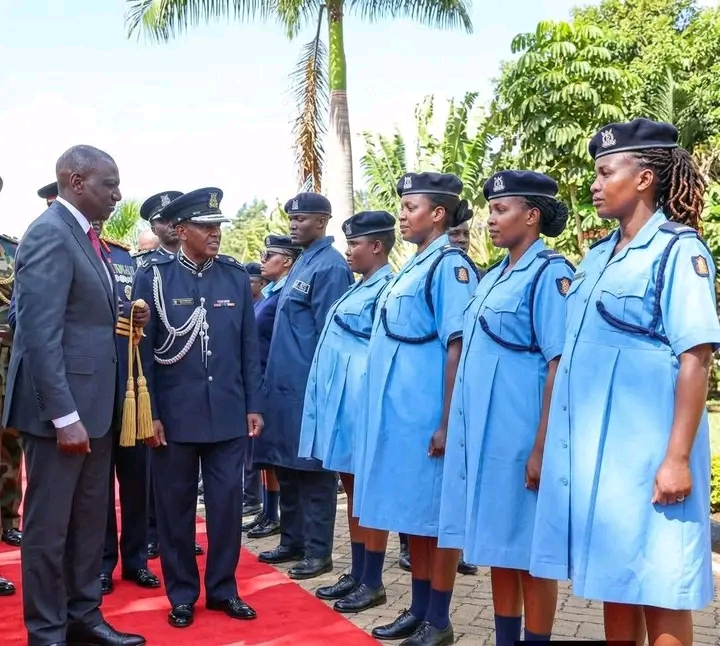
The new Kenya Police Service uniform is part of a wider reform programme and has attracted considerable attention since it was unveiled on August 28, 2026, during the passing-out parade at the Kenya Police Training College in Kiganjo, Nyeri County. President William Ruto officially unveiled the new attire, which was initially showcased on newly graduating officers.
What the new uniform looks like
The redesigned General Duty Kenya Police uniform features:
Light/sky-blue shirts or blouses
Deep navy-blue trousers
Matching headgear/berets
The Kenyan flag and police identification markings incorporated into the uniform
A similar shirt-and-trouser design for both male and female General Duty officers.
The new outfit replaces the Persian-blue/dark-blue uniform introduced in 2018.
Why was the uniform changed?
According to the National Police Service, the change was not simply a decision made overnight. It followed the wider police reform process associated with the Maraga Task Force on Police Reforms.
The NPS says consultations were conducted with police officers, who expressed dissatisfaction with the existing uniform and overwhelmingly supported changing it. The Kenya Police Service Uniform Committee subsequently worked with the Kenya Bureau of Standards (KEBS) to develop standards for the replacement uniform.
Inspector General Douglas Kanja has also said the new uniform is expected to improve officers' morale, confidence and pride as they carry out their duties.
When will officers start wearing it?
The rollout is progressive rather than an immediate nationwide replacement. Newly graduating constables were among the first officers to wear the new uniform, with the wider rollout to General Duty officers expected to continue across the country. Reports indicated that the transition was scheduled to begin from August 31, 2026.
What about GSU and Administration Police?
This is an important distinction: the new uniform is specifically for Kenya Police Service General Duty officers.
The Administration Police Service (APS) and General Service Unit (GSU) are not being switched to this uniform as part of the initial rollout. Their existing uniforms remain in use.
Who is manufacturing the uniforms?
There has been controversy surrounding the procurement, particularly reports concerning a KSh2.8 billion tender.
The NPS issued a clarification on August 30, saying that Bedi Investments Limited was lawfully awarded the contract to manufacture and stitch the new General Duty uniforms. The Service specifically denied reports that Nalitex Limited had been awarded the contract or participated in the procurement process.
According to the NPS, four Kenyan textile manufacturers were invited to submit samples as part of efforts to promote local manufacturing under the Buy Kenya, Build Kenya approach.
Why the uniform is attracting controversy
The cost and procurement process have generated public and political debate. Some critics have questioned whether changing uniforms should be a priority when police officers face other challenges such as equipment, housing, transport and remuneration.
Police leadership, however, argues that the uniform change is one component of a broader reform programme, rather than an isolated expenditure. IG Kanja has linked the reforms to improvements in equipment, transport, housing, remuneration and police personnel.
In short: Kenya has begun replacing the 2018 dark/Persian-blue General Duty police uniform with a light-blue and deep-navy design, beginning with newly graduated officers and progressively extending it to other General Duty officers. The change is presented by NPS as part of long-term police reforms aimed partly at improving officers' morale and public confidence.
The new Kenya Police Service General Duty uniform tender was awarded to Bedi Investments Limited, according to a clarification issued by the National Police Service (NPS) on August 30, 2026.
Here is what the NPS says about the process:
Bedi Investments Limited was awarded the contract to manufacture and stitch the new General Duty police uniforms.
Four Kenyan textile manufacturers were invited to submit samples: Bedi Investments, Rivatex East Africa, Thika Textile Mills, and Sunflag Textiles & Knitwear Mills.
Only Bedi Investments and Rivatex submitted samples within the required period.
Following evaluation and public participation, Bedi Investments' sample was selected and approved.
The subsequent procurement was conducted under the Public Procurement and Asset Disposal Act, 2015, according to the NPS.
What about Nalitex?
The NPS has strongly denied reports that Nalitex Limited received the tender. It says Nalitex did not participate in the procurement process, was not awarded the contract, was not a subcontractor, and did not receive a purchase order or payment from the NPS.
There have been reports putting the value of the procurement at around KSh2.8 billion, which has generated public debate over the tender. However, the NPS's clarification specifically identifies Bedi Investments Limited as the awarded contractor.
The KSh2.8 billion police-uniform controversy is mainly about who received the contract, the identity of the supplier, and allegations that a politically connected company was involved.
What triggered the controversy?
Reports published around August 29, 2026, alleged that a company called Nalitex Limited was connected to a roughly KSh2.8 billion deal to supply Kenya's new General Duty police uniforms. The reports raised questions because Nalitex was incorporated in May 2024, relatively shortly before the uniform rollout. The Standard also reported that its listed Nairobi office could not be traced and that its postal address was shared with an auditing firm and a property business allegedly linked to President William Ruto's family.
Those reports led to questions about whether a relatively new company had been positioned to receive a multibillion-shilling government contract and whether there were political connections behind the procurement.
NPS's response
On August 30, the National Police Service strongly rejected the reports.
The NPS said Nalitex Limited had absolutely no role in the procurement. According to the Service, Nalitex:
did not participate in the tender;
was not awarded the contract;
was not a subcontractor;
did not receive a purchase order; and
did not receive payment from NPS.
Instead, NPS identified Bedi Investments Limited as the company that was legally awarded the contract to manufacture and stitch the new General Duty uniforms.
How NPS says the tender was handled
According to NPS, four Kenyan textile manufacturers were invited to submit samples:
Bedi Investments Limited
Rivatex East Africa Limited
Thika Textile Mills Limited
Sunflag Textiles & Knitwear Mills
NPS says only Bedi Investments and Rivatex submitted samples within the required period. Following evaluation and public participation, Bedi's sample was selected and approved, after which the procurement proceeded under the Public Procurement and Asset Disposal Act and applicable regulations.
So where does the KSh2.8 billion figure come from?
This is the crucial point: the KSh2.8 billion figure has been widely reported in connection with the controversy, but the NPS's clarification does not validate the allegation that Nalitex received a KSh2.8 billion contract.
In fact, the NPS is saying the opposite: Nalitex was never part of the procurement. The reports that initially connected Nalitex to the deal are therefore being disputed by the police service.
What remains to be established?
The controversy therefore hasn't simply become "Nalitex got the tender." There are two competing accounts:
Media reports: raised questions about a KSh2.8 billion uniform deal and alleged connections involving Nalitex and people linked to the President's family.
NPS's official position: says those reports are wrong, Nalitex was never involved, and Bedi Investments Limited was the legitimate contractor.
So, at this point, it would be inaccurate to state as a proven fact that KSh2.8 billion was corruptly awarded to Nalitex. The allegation has been made in media reports, but the NPS has expressly denied the central claim.

You Might Also Like
-
Winnie Byanyima Appeals for Besigye to Receive Specialised Treatment in Geneva
-
Rosemary Chemutai Koech was buried at her parents’ home in Chepseon, Kipkelion, on Friday evening, August 28, 2026, following arrangements by her family and the Kipkendek clan. Her recorded next of kin were her sister, Judy Koech-Oyamo, and son, Charles Migwe Kimwatu. The clan explained that the n
-
Mudavadi Represents President Ruto at 21st Extraordinary African Union Summit in Angola
-
The death toll from devastating floods and mudslides in Nepal has risen to at least 781, while 2,502 people remain missing, as rescue teams continue a desperate search for survivors across some of the worst-hit areas of the Himalayan nation.
-
ELDORET, Kenya — Police have launched a manhunt for a police officer suspected of fatally shooting a 45-year-old woman at a GSU mess compound in Eldoret following what investigators believe may have been a dispute linked to a suspected love triangle
-
Dr Joyce Laboso Hospital Finally Ready as Bomet Prepares for Landmark Healthcare Opening Bomet County is preparing to welcome the Dr Joyce Laboso Mother and Child Hospital, a Sh300 million, 300-bed Level Five facility in Longisa. The hospital has been completed and is awaiting official commissionin