



Ruto Tours Dangote’s Mega Refinery in Lagos Ahead of Historic Lamu Groundbreaking
President William Ruto's tour of the Dangote Petroleum Refinery in Lagos comes at a strategically important moment for Kenya. Just five days after the September 25 visit, Kenya is scheduled to host the groundbreaking ceremony for the proposed Dangote East African Refinery in Lamu on September 30. The Lagos refinery gave Ruto an opportunity to see firsthand the scale, technology and infrastructure involved in operating a major petroleum-processing facility. He has presented the Nigerian plant as an example of what governments, investors and financial institutions can achieve through cooperation. The proposed Lamu refinery is being presented as a major component of Kenya's plans for energy security, industrialisation, employment and regional trade. With a proposed processing capacity of about 700,000 barrels of crude oil per day and a projected investment running into tens of billions of dollars, its development would have implications well beyond Lamu. The upcoming groundbreaking will therefore be an important milestone. The next phase will ultimately depend on financing, construction, crude supply, infrastructure, environmental and community considerations, as well as the project's ability to establish sustainable markets for its products. If successfully implemented, the Lamu refinery would become a major addition to Kenya's energy infrastructure and could strengthen the country's ambition to serve as a petroleum-processing and logistics hub for East and Central Africa.
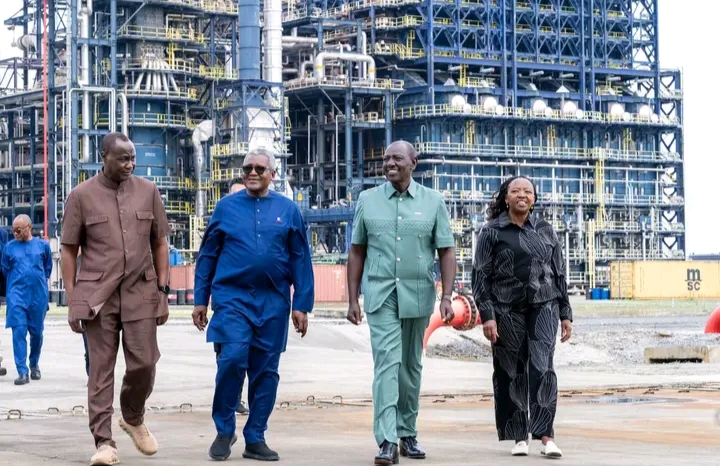
President William Ruto on Friday, September 25, 2026, toured the massive Dangote Petroleum Refinery in Lekki, Lagos, Nigeria, just days before Kenya is expected to host the groundbreaking ceremony for the proposed Dangote East African Refinery in Lamu. The visit has placed renewed attention on Kenya's ambitions to establish a major petroleum-processing and industrial hub on the country's northern coast.
Ruto's Lagos tour came ahead of the planned September 30 groundbreaking ceremony in Lamu. The President was accompanied by First Lady Rachel Ruto and senior officials and was received by Nigerian businessman Aliko Dangote, whose business group is behind both the operational Nigerian refinery and the proposed Kenyan project.
The timing of the visit is significant because Kenya is preparing to move from planning and negotiations into the construction phase of what the government describes as a transformative energy and industrial project.
Ruto's visit to the Dangote refinery
During his visit to Lagos, President Ruto toured the Dangote Petroleum Refinery and received an overview of the facility's operations, infrastructure and refining processes.
The Nigerian facility has a crude-processing capacity of about 700,000 barrels per day, according to Ruto, and produces more than 100 million litres of petrol, diesel and aviation fuel daily. The President also highlighted the infrastructure supporting the refinery, including approximately 120 kilometres of subsea infrastructure used to transport crude oil from ships to the facility.
For Kenya, the visit provides an opportunity to observe an already-developed large-scale refinery associated with the same investor who is expected to participate in the Lamu project.
Ruto described the Nigerian refinery as an example of what African governments, private investors and financial institutions can accomplish through cooperation. The visit therefore comes at a time when Kenya is seeking to demonstrate that the proposed Lamu refinery can become more than a fuel-processing plant and instead serve as an anchor for broader industrial development.
Why the Lagos visit matters to the Lamu project
The planned refinery in Lamu is expected to have a major role in Kenya's long-term energy strategy.
Kenya currently relies heavily on imported refined petroleum products to meet domestic demand. A refinery capable of processing large volumes of crude could allow some petroleum products consumed in Kenya and neighbouring countries to be produced closer to their markets.
Government officials have also presented the proposed facility as a project that could strengthen energy security, increase local value addition and support industrialisation. President Ruto has said the Lamu refinery will be larger than the Nigerian facility.
The government has linked the project to the broader ambition of turning Kenya into a regional processing, distribution and logistics centre.
Deputy President Kithure Kindiki has similarly described the refinery as a project that could position Kenya and East Africa as a petrochemical industrial hub and competitive energy logistics centre.
The September 30 groundbreaking
The next major milestone is the planned groundbreaking ceremony in Lamu on September 30, 2026.
The ceremony is expected to bring together Kenyan officials, investors, regional leaders and other stakeholders. Preparations have been underway in Lamu, including security and logistical arrangements for the anticipated gathering. Kenya News Agency reported that authorities were preparing for a large number of dignitaries and attendees.
The groundbreaking will be important because it is expected to mark the transition of the Lamu refinery from a major investment proposal into the construction stage.
Reports have placed the estimated investment at between approximately $15 billion and $17 billion, with the Kenyan government describing it as one of the country's largest prospective investments.
A refinery designed for a regional market
One of the central arguments behind the Lamu refinery is its potential to serve markets beyond Kenya.
East African countries consume large quantities of petroleum products, much of which are imported. A major refinery located on Kenya's coast could potentially provide refined products to Kenya and neighbouring countries, depending on the final commercial arrangements, infrastructure and market conditions.
The location of Lamu is particularly important because of its connection to the Lamu Port-South Sudan-Ethiopia Transport (LAPSSET) Corridor.
LAPSSET was conceived as a major transport and trade corridor connecting Kenya with South Sudan and Ethiopia. The proposed refinery could add an important energy component to this infrastructure network and increase the economic activity surrounding Lamu Port.
The EastAfrican has reported that the refinery could provide a new economic anchor for LAPSSET, whose wider development has faced challenges in attracting sufficient commercial activity.
Lamu could become an energy and industrial centre
The refinery's significance extends beyond petroleum production.
According to government plans and recent reports, the Lamu development is expected to be connected to wider industrial activities. President Ruto has said industries could emerge around the refinery, including fertiliser, chemical and packaging manufacturing.
Such industries would potentially create demand for skilled and semi-skilled workers, transportation services, construction companies, logistics providers and other businesses.
This is why government officials have repeatedly described the refinery as an industrialisation project rather than simply an energy project.
The development could also create opportunities for businesses involved in engineering, equipment supply, maintenance, security, accommodation, food services, transport and other support services.
Expected employment opportunities
Employment is another major issue surrounding the Lamu refinery.
President Ruto has said the project could create about 60,000 jobs, while other government statements have referred to more than 50,000 jobs. These figures include projected employment associated with the wider industrial ecosystem and should therefore not necessarily be interpreted as permanent direct refinery employment alone.
For Lamu residents, employment and business opportunities will be among the key measures by which the project is judged.
Local leaders have also raised the need for adequate infrastructure and public services to support workers and new businesses that could come with the development.
Kenya News Agency reported that local officials expect the project to generate direct employment opportunities for residents, while wider supply-chain and industrial activities could generate additional employment.
Connection with Kenya's crude oil
Another important part of the project is Kenya's own crude oil resources.
Kenya has oil resources in Turkana, particularly around the Lokichar Basin. Reports on the Lamu refinery have linked the proposed facility to the possibility of processing crude from Kenya's oilfields as well as other crude supplies.
Having domestic crude available for refining could potentially reduce the distance between crude production and petroleum processing.
However, the commercial and infrastructure arrangements required to ensure a consistent crude supply will be important to the project's long-term operation.
A refinery of this scale requires dependable access to crude, reliable infrastructure, sufficient water and energy supplies, efficient storage facilities and access to markets for its refined products.
Lessons from the Nigerian refinery
Ruto's visit to Lagos also highlights the practical lessons Kenya can draw from Dangote's Nigerian experience.
The Dangote refinery demonstrates the scale of infrastructure required to develop a major petroleum-processing facility. Its development involved enormous investment in refining equipment, crude-oil transportation infrastructure, storage, power and related facilities.
During his Lagos tour, Ruto specifically pointed to the infrastructure developed to bring crude from ships to the refinery.
This is particularly relevant to Lamu because the Kenyan project is also planned for a coastal location with access to maritime transport.
The experience in Lagos can therefore provide a reference point for discussions about port infrastructure, crude supply, storage, transportation and connections to regional markets.
Financing and preparation for Lamu
The Lamu project has also involved discussions about financing.
On September 21, Ruto met Aliko Dangote and Africa Finance Corporation Chief Executive Officer Samaila Zubairu on the sidelines of the United Nations General Assembly in New York. According to reports, the discussions focused on financing arrangements and final preparations for the Lamu project.
The discussions indicate that financing remains an important component of moving such a large project forward.
The refinery's enormous projected cost means that its construction will require significant financial resources and long-term commercial planning.
Importance to Kenya's energy security
Energy security is one of the strongest reasons the government has given for supporting the refinery.
A domestic or regional refining facility could potentially reduce Kenya's exposure to international disruptions affecting imported refined petroleum products.
Fuel prices and availability can be affected by global crude prices, shipping costs, geopolitical developments and disruptions along major international shipping routes.
A refinery in Lamu would not eliminate those risks because it would still depend on crude supplies, infrastructure and international market conditions. However, the government's position is that increasing regional refining capacity could strengthen supply resilience.
Challenges and questions surrounding the project
Despite the government's strong emphasis on the refinery's potential, the project also faces important questions.
These include financing, construction timelines, crude supply, infrastructure requirements, environmental considerations and the economic benefits that will reach local communities.
There are also questions about public participation. Kenya News Agency reported that some Lamu leaders had called for more engagement with residents, local leaders and landowners around the proposed project area.
Such concerns are significant because large infrastructure projects can affect land use, livelihoods, environmental resources and local economies.
Ensuring that local communities understand the project and participate in relevant processes will therefore remain an important part of its implementation.
What the Lamu groundbreaking could mean
The September 30 groundbreaking is expected to be watched closely across Kenya and the wider East African region.
If construction proceeds as planned, the refinery could become one of the largest energy-related infrastructure projects in the region.
Its potential impact extends from petroleum processing to logistics, manufacturing, employment, port activity and regional trade.
For Lamu, the project could also provide an additional economic anchor for the county and strengthen the role of Lamu Port within the wider LAPSSET corridor.
For Kenya, it represents an attempt to move further up the petroleum value chain by processing crude and producing petroleum and petrochemical products locally or regionally rather than depending overwhelmingly on imported refined products.
For East Africa, the project could eventually provide another source of refined petroleum products for regional markets.

You Might Also Like
-
Dr Joyce Kithure's call for young people to use digital media for climate action places Kenya's youth at an important intersection between technology, environmental conservation and public advocacy. Speaking during the launch of the Youth Climate Policy and Advocacy Training programme at KISE, she
-
President William Ruto responds to Kalonzo Musyoka, saying the Tsiekuru road is among many infrastructure projects his administration is pursuing across the country.
-
Former Deputy President Rigathi Gachagua has pledged to intensify the fight against drug trafficking, promising tougher border controls to prevent heroin, cocaine and cannabis from entering Kenya within the first year of his administration.
-
President William Ruto's September 26, 2026 visit to Taita Taveta County focused on development, with particular attention to technical education, land ownership and infrastructure. The President laid the foundation stone for Wumingu Technical and Vocational College, participated in the Coast-wide t
-
Mike Bloomberg's discussions with President William Samoei Ruto bring attention to three important dimensions of Kenya's development agenda: healthier food choices, the clean-energy transition and ocean conservation. The front-of-package warning-label debate is focused on giving Kenyan consumers cl
-
The Koitaleel Samoei University College main campus in Nandi Hills is now approaching a major milestone after years of delays. The latest September 2026 reports place construction at about 85 per cent, with an administration block and 14 lecture halls forming key components of the development. Finis