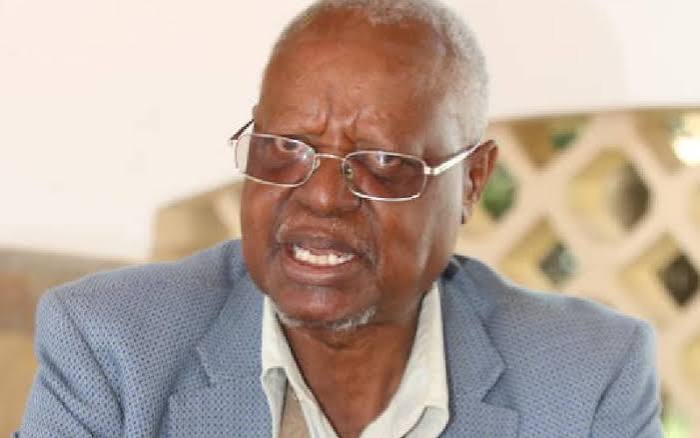
Former Aldai Member of Parliament and former Deputy Speaker of the National Assembly, Samuel Ng’eny, has passed away
Former Aldai Member of Parliament and Deputy Speaker of the National Assembly, Samuel Ng’eny, has passed away, marking the loss of a veteran public servant who made significant contributions to Kenya's education sector, parliamentary leadership and public administration. Ng’eny served as Aldai MP from 1979 and held the position of Deputy Speaker between 1983 and 1988. He also served as the first Black principal of Kapsabet Boys High School, a commissioner at the former Electoral Commission of Kenya and a director at the Kenya Tea Development Agency. His death brings to an end a distinguished career spanning several decades of service to the country and its people.
Former Aldai Member of Parliament and former Deputy Speaker of the National Assembly, Samuel Ng’eny, has passed away, marking the loss of a former legislator who served in Kenya's parliamentary leadership and represented the people of Aldai Constituency.
His death brings attention to his contribution to the country's legislative process and the political history of Aldai, in Nandi County. During his time in Parliament, Ng’eny held public office at a period when the National Assembly played a central role in debating national policies, scrutinising government decisions and representing the interests of communities across the country.
As a former Member of Parliament, Ng’eny was part of the leadership entrusted with representing constituents and participating in national decision-making. The parliamentary role involves presenting the concerns of local communities, participating in debates on proposed laws, examining government policies and contributing to discussions on matters affecting the country.
The death of former Aldai Member of Parliament and Deputy Speaker of the National Assembly, Samuel Kipyebei Arap Ng’eny, has marked the end of an era for a veteran Kenyan leader whose public service spanned education, parliamentary leadership, electoral administration and community development.
Ng’eny, who represented Aldai Constituency in Nandi County, was among the leaders who played significant roles in Kenya's parliamentary history during the early years of the country's political development. His passing has drawn attention to his contribution to public service and the different responsibilities he undertook throughout his career.
His political journey began when he was first elected to Parliament in 1979 as the Member of Parliament for Aldai Constituency. His election marked the beginning of a period of service in which he participated in parliamentary debates, represented the interests of his constituents and contributed to discussions on national issues.
In 1983, Ng’eny rose to the position of Deputy Speaker of the National Assembly, a role he held until 1988. His appointment to the parliamentary leadership placed him among the senior figures responsible for overseeing proceedings in the House and ensuring that parliamentary business was conducted in accordance with established rules and procedures.
The position of Deputy Speaker carries significant responsibilities in the legislative process. The office holder assists in presiding over parliamentary sittings, maintaining order during debates and ensuring that members follow the procedures governing discussions and decision-making. It also requires impartiality, patience and a strong understanding of parliamentary practices.
During his five years in the position, Ng’eny was involved in guiding parliamentary proceedings at a time when Kenya's political and institutional landscape was undergoing various changes. His role placed him at the centre of legislative activities and gave him an opportunity to participate in parliamentary engagements both locally and internationally.
His contribution to parliamentary leadership was also reflected in his participation in international conferences and professional programmes focused on legislative practices. Such engagements provided opportunities for parliamentary leaders to exchange experiences, learn from other legislatures and strengthen their understanding of democratic institutions.
In 1984, he represented the Speaker at an international conference in Wellington, New Zealand, and later undertook another parliamentary engagement in New Delhi, India, in 1986. He also participated in training programmes on parliamentary practices and procedures in the United Kingdom, the United States and Germany.
These engagements exposed him to different parliamentary systems and approaches to legislative administration. They also formed part of his experience in public leadership, particularly in understanding how legislative institutions operate and how parliamentary procedures can support effective democratic governance.
Ng’eny's public service career, however, extended beyond politics and Parliament. Before becoming a prominent political figure, he had established himself in the education sector, where he made a notable contribution to the development of learning institutions.
One of his significant achievements in education was becoming the first Black principal of Kapsabet Boys High School in June 1969. His appointment marked an important moment in the institution's history, as he took over leadership during a period when the country's education system was undergoing transformation following independence.
As principal, he was responsible for overseeing academic programmes, managing school administration and guiding teachers and learners towards achieving educational objectives. School leadership requires the ability to coordinate teaching activities, maintain discipline, manage resources and create an environment that supports academic development.
His experience in education helped shape his wider understanding of leadership and public service. Education remains one of the most important foundations of national development, and school administrators play a major role in preparing young people for future responsibilities.
Kapsabet Boys High School would continue growing into one of Kenya's recognised learning institutions, producing students who have gone on to serve in different professional and public leadership positions. Ng’eny's contribution to the institution forms part of his wider legacy in the education sector.
Beyond his work in education and Parliament, Ng’eny also served as a commissioner at the former Electoral Commission of Kenya. His involvement in electoral administration placed him in another important area of public service, where the management of elections and the protection of democratic processes were central responsibilities.
Electoral institutions play a critical role in ensuring that citizens exercise their constitutional right to vote and that electoral processes are conducted according to the law. Their responsibilities include managing elections, overseeing electoral procedures and supporting public confidence in democratic institutions.
His experience as a former legislator would have provided valuable familiarity with the political environment in which electoral institutions operate. The combination of experience in education, Parliament and electoral administration demonstrated the different areas in which he participated in public affairs.
Ng’eny also served as a director at the Kenya Tea Development Agency, where he contributed to the institution's leadership and administration. The tea sector has long been an important part of Kenya's agricultural economy, supporting farmers, businesses and communities across several regions.
The industry provides livelihoods to thousands of households and contributes to the country's export earnings. Institutions involved in the sector have an important responsibility in supporting farmers, strengthening production and ensuring that the interests of growers are considered in the management of the industry.
His involvement in the agency further expanded his experience beyond political and educational leadership, placing him in an institution connected to one of Kenya's major agricultural industries.
Ng’eny's life and career also reflected a strong connection to community and religious activities. He was an active member of the Anglican Church of Kenya and was recognised as a respected elder within the Nandi community.
Religious institutions have historically played an important role in community development, particularly through education, social support and the promotion of moral values. Church leadership also provides opportunities for individuals to participate in community activities and contribute to discussions affecting society.
His involvement in the church formed another part of his public life, reflecting his engagement with institutions beyond government and politics. Through his different responsibilities, he remained connected to the community he had represented in Parliament.
His political journey was also shaped by the country's changing electoral environment. Ng’eny did not contest the 1988 General Election, a period associated with the controversial queue-voting system commonly referred to as Mlolongo. The voting method generated considerable debate over electoral transparency and political competition.
His decision not to seek re-election came during a period when Kenya's political environment was characterised by significant challenges surrounding party nominations and electoral processes. His departure from elective politics did not, however, bring his public involvement to an end.
In later years, he continued participating in national and community affairs, drawing from his experience in education, parliamentary leadership and public administration. His presence in public discussions also reflected the role former leaders can play in offering guidance and sharing their experiences with younger generations.
In 2015, Ng’eny was recognised in the Senate during proceedings that acknowledged his service as Deputy Speaker of the National Assembly between 1983 and 1988. His earlier election as Aldai MP in 1979 and his subsequent parliamentary leadership were highlighted as important milestones in his public career.
The recognition demonstrated the continued relevance of former legislators in the country's political and institutional history. Former members of Parliament often possess valuable experience in governance, legislation and public administration that can contribute to discussions on national development and the strengthening of democratic institutions.
Ng’eny's career also offers a picture of the different pathways through which individuals can contribute to national development. His work in education involved shaping the learning environment for young people, while his parliamentary responsibilities placed him in the country's legislative leadership. His later engagements in electoral administration and the agricultural sector further demonstrated his participation in public institutions.
For the people of Aldai Constituency, his passing represents the loss of a former representative who served the area during an important period in Kenya's political history. Constituency representation involves more than participation in parliamentary debates, as elected leaders are also expected to communicate community concerns, engage with national institutions and contribute to decisions affecting their constituents.
His years in Parliament remain part of the political history of Aldai and Nandi County. His experience also provides an example of the responsibilities undertaken by leaders who served during the country's earlier parliamentary periods.
The loss is also significant for the wider parliamentary community, where the passing of former legislators often provides an opportunity to reflect on the contributions of those who participated in shaping the institution over the years.
As Kenya continues developing its democratic institutions, the experiences of former parliamentary leaders remain part of the country's political record. Their contributions help provide historical context to the evolution of Parliament, the development of legislative procedures and the changing relationship between elected representatives and the communities they serve.
Ng’eny's journey from educationist to legislator, Deputy Speaker and public administrator reflected a long period of involvement in different areas of national life. His service across several institutions placed him among the individuals whose careers extended beyond elective politics.
His death therefore marks the loss of a veteran public servant whose professional and leadership experiences touched education, governance, agriculture, electoral administration and religious life. His contribution to Kapsabet Boys High School, Aldai Constituency and the National Assembly remains part of his public record.
As the news of his passing reaches former colleagues, community members and those who worked with him in different institutions, attention will turn to his family's loss and the legacy he leaves behind.

You Might Also Like
-
German Federal President Frank-Walter Steinmeier is expected to arrive in Kenya on November 25–26, 2026, for a two-day official visit that will include high-level bilateral talks with President William Ruto at State House. The visit is expected to strengthen diplomatic relations between Kenya and
-
President William Ruto has renewed his criticism of opposition leaders who walked out of a consultative meeting with the Independent Electoral and Boundaries Commission (IEBC), accusing them of transferring their frustrations over disagreements on who should lead their presidential campaign to the e
-
Embakasi East MP Babu Owino has reaffirmed his political relationship with Nairobi Senator Edwin Sifuna, describing him as his brother and dismissing speculation that their individual political ambitions could create divisions within the Linda Mwananchi movement. Babu maintained that their political
-
A political party has moved to court seeking to suspend the recruitment of the Independent Electoral and Boundaries Commission (IEBC) Chief Executive Officer, citing alleged integrity concerns surrounding the selection process. The legal challenge comes at a critical time as the electoral commission
-
The Independent Electoral and Boundaries Commission (IEBC) has criticised opposition leaders for walking out of a consultative meeting on electoral preparedness ahead of the 2027 General Election. The commission accused the leaders of missing an important opportunity to raise concerns, discuss propo
-
Police Headquarters has ordered a mandatory nationwide physical headcount of all National Police Service officers following reports that some serving officers are allegedly being illegally recruited by foreign agencies to work as mercenaries abroad. The exercise is expected to establish the whereabo