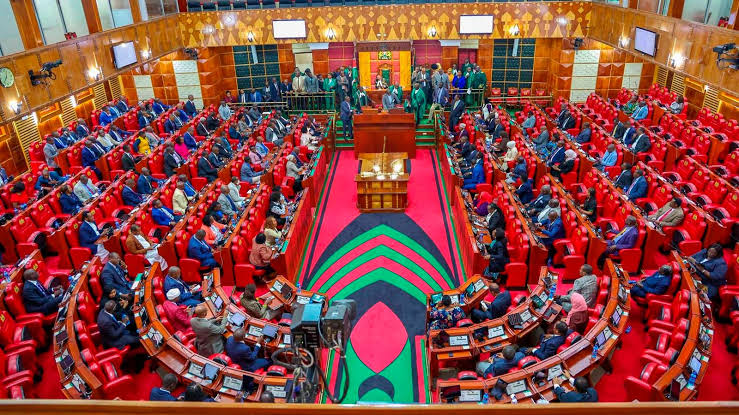
Members of the National Assembly have rejected Senate amendments on the tallying and electronic transmission of presidential election results ahead of the 2027 General Election
Members of the National Assembly have rejected Senate amendments on the tallying and electronic transmission of presidential election results ahead of the 2027 General Election. The proposed changes, negotiated by teams representing President William Ruto and the late Raila Odinga, sought to introduce clear timelines for transmitting results from polling stations. They also aimed to ensure electronically transmitted figures accurately reflected votes counted, verified and declared at polling stations. The decision has renewed debate over electoral transparency, accountability and public confidence in Kenya's electoral process. Attention now shifts to the next stage of the legislative process as Parliament considers the proposed reforms. The disagreement between the two Houses could trigger further negotiations over the contested provisions. The outcome will determine whether the proposed safeguards are included in the final legislation. Electoral reforms remain a key issue as the country prepares for the 2027 polls.
Members of the National Assembly have rejected amendments proposed by the Senate on the tallying and electronic transmission of presidential election results, raising fresh questions about the legislative process surrounding changes to Kenya's electoral framework ahead of the 2027 General Election.
The proposed amendments were part of recommendations negotiated by teams representing President William Ruto and the late former Prime Minister Raila Odinga. The discussions were aimed at addressing concerns surrounding the management of elections, particularly the transmission, verification and declaration of presidential election results.
The Senate proposals sought to introduce specific timelines within which election results would be electronically transmitted from individual polling stations. The intention was to prevent unnecessary delays that could affect the announcement of presidential election outcomes and create uncertainty during the electoral process.
Under the proposed changes, electronic transmission of results was expected to follow clearly defined timelines, ensuring that information from polling stations reached the relevant electoral authorities within an established period. This was intended to strengthen efficiency and improve the management of election results.
The proposals also focused on ensuring that electronically transmitted results accurately represented the votes counted, verified and declared at the respective polling stations. This was considered an important safeguard in maintaining consistency between the physical results announced at polling stations and the figures received electronically by the electoral commission.
The rejection by Members of the National Assembly means the Senate-backed proposals will face further legislative hurdles, potentially prolonging discussions over how presidential election results should be transmitted and verified.
Election result transmission has remained one of the most closely watched aspects of Kenya's electoral system. The process determines how results recorded at polling stations are communicated to the national tallying centre, where the final presidential election outcome is established.
The issue has attracted significant public attention because of the importance of transparency, accuracy and accountability in determining the winner of a presidential election. Political parties, election observers and members of the public have consistently emphasised the need for a credible process that allows results to be independently verified.
The proposed amendments were intended to address some of the concerns associated with delays in transmitting election results. By establishing clear timelines, lawmakers supporting the changes sought to create a more predictable process and reduce uncertainty during the tallying period.
However, the rejection by the National Assembly demonstrates that there are still differences within Parliament over the proposed changes and the appropriate approach to regulating the transmission of presidential election results.
The proposed amendments were particularly significant because they sought to strengthen the relationship between physical result forms and electronic records. Under the proposed framework, the Independent Electoral and Boundaries Commission (IEBC) would be required to ensure that figures uploaded electronically matched the results officially recorded at polling stations.
The Senate's version of the Elections (Amendment) Bill proposed that presidential election results be electronically transmitted within two hours after their declaration at polling stations. Where the commission failed to meet the proposed deadline, it would be required to provide an explanation for the delay.
The proposals also included the publication of polling station results forms through an online public portal maintained by the IEBC. This would allow candidates, political parties, election observers, journalists and members of the public to access the records and compare the results announced at polling stations with those received at higher tallying centres.
Another important aspect of the proposed changes involved the physical delivery of election documents. The amendments sought to maintain the use of physical result forms alongside electronic transmission, ensuring that the tallying process could be checked against original documents completed and signed at polling stations.
This approach was intended to provide additional safeguards against discrepancies between results declared at polling stations and figures received at the national tallying centre. It would also make it easier to identify and explain any differences arising during the transmission and verification process.
The debate has also drawn attention to the role of the IEBC chairperson and the commission in determining and declaring presidential election results. Kenya's Constitution gives the IEBC responsibility for conducting presidential elections and declaring the final outcome in accordance with established constitutional requirements.
Under Article 138 of the Constitution, a presidential candidate must secure more than half of all valid votes cast and at least 25 per cent of the votes cast in more than half of the 47 counties to win in the first round.
The tallying process begins at individual polling stations, where votes are counted openly and recorded in official result forms. The figures are subsequently transmitted electronically and physically delivered through the established electoral structures for verification and aggregation.
The electronic transmission system is important because it allows election stakeholders to follow the movement of results from polling stations to the national tallying centre. It also provides an opportunity to compare electronically transmitted figures with the physical documents used during the tallying process.
Kenya's previous presidential elections have demonstrated the importance of having a transparent and verifiable system. Disagreements over the handling and declaration of results have previously resulted in legal challenges, making electoral reforms a major issue in discussions ahead of the next General Election.
The debate surrounding the proposed amendments is therefore not limited to how quickly results should be transmitted. It also concerns the procedures through which election results are verified, the accessibility of electoral information and the responsibilities of institutions involved in declaring the presidential winner.
The National Assembly's decision to remove the proposed changes to Section 39 of the Elections Act has also generated public discussion over the livestreaming of election results.
The existing provision requires the IEBC to establish a mechanism for livestreaming results as announced at polling stations, with the streamed results serving the purpose of public information. The National Assembly maintained that by deleting the clause seeking to replace Section 39, MPs had retained this existing requirement rather than abolishing it.
This clarification followed concerns that the proposed legislation could weaken public access to election results and limit the ability of Kenyans to monitor the tallying process.
Members of Parliament supporting the decision have maintained that the existing legal framework should remain in place, particularly following a court determination on the constitutionality of provisions governing the tallying and verification of presidential election results.
The issue has also attracted attention because livestreaming and electronic transmission serve different purposes. Electronic transmission involves sending election results through the IEBC's digital systems, while livestreaming allows the public to watch the announcement of results at polling stations.
Both processes are important in promoting public access to electoral information, although neither should be confused with the official legal declaration of the presidential election outcome.
The September 2026 High Court ruling on national tallying and verification also forms part of the wider debate. The court upheld the constitutional framework for national tallying while emphasising that verification should involve checking and aggregating results rather than changing figures already declared and certified at constituency level.
The rejection of the Senate proposals has consequently placed the Elections (Amendment) Bill back before the Senate for further consideration. Under the legislative process, the Senate will have to consider the changes made by the National Assembly and determine whether to agree with them.
If the two Houses fail to reach an agreement, the Constitution provides for the establishment of a mediation committee to resolve disagreements over the Bill. The outcome of that process will determine the final version of the legislation before it can be presented to the President for assent.
With the 2027 General Election approaching, the debate over electoral reforms is expected to remain an important subject in Parliament and among political stakeholders.
The disagreements have highlighted the competing approaches to improving the country's electoral system, particularly concerning transparency, accountability, timely transmission of results and public confidence in the final outcome.
For millions of Kenyan voters, the central concern remains whether the electoral system will provide a process that is transparent, accurate and capable of withstanding scrutiny from all participating political parties.
The discussions also place responsibility on Parliament and the IEBC to ensure that any changes to electoral laws are clearly understood and implemented before the next election.
As the legislative process continues, attention will remain on the Senate's response to the National Assembly's amendments and whether the two Houses can reach a common position on the proposed electoral reforms.

You Might Also Like
-
Energy and Petroleum Cabinet Secretary Opiyo Wandayi has urged ODM leaders to abandon hardline demands and support President William Ruto’s re-election bid unconditionally ahead of the 2027 General Election. His remarks come amid growing debate within ODM over a possible pre-election agreement wit
-
The eight East African Community Partner States have adopted a regional Artificial Intelligence Strategy and approved a new AI learning module for universities. The initiative seeks to integrate artificial intelligence education into both technical and non-technical degree programmes. Students will
-
The multi-agency rescue operation at the collapsed 18-storey building in Nairobi’s Eastleigh is expected to conclude today after approximately 90% of the rubble was cleared. Rescue teams are now concentrating on the rear section and basement, where missing persons are believed to be trapped. Six p
-
ODM has reportedly endorsed President William Ruto as its preferred presidential candidate for the 2027 General Election. The party has also reached an agreement with UDA to establish a joint campaign committee and operate a shared treasury account. However, negotiations over the sharing of governme
-
Kenya has challenged Saudi Arabia’s decision to suspend travel by its citizens to Kenya and halt visa issuance to Kenyan travellers amid the Ebola outbreak. Health Cabinet Secretary Aden Duale has termed the restrictions excessive, arguing that they are not supported by the prevailing epidemiologi
-
Detectives have arrested two additional suspects in connection with the murder of 65-year-old Evelyne Mukiri Mbaabu, who was killed at her home in Kithoka Village, Meru County, on August 7, 2026. The newly arrested suspects, identified as the deceased's brother and sister-in-law, are alleged to have