



Chebole–Siongiroi–Labotiet–Kilgoris Road Upgrade Gains Momentum After Siongiroi Public Participation Forum
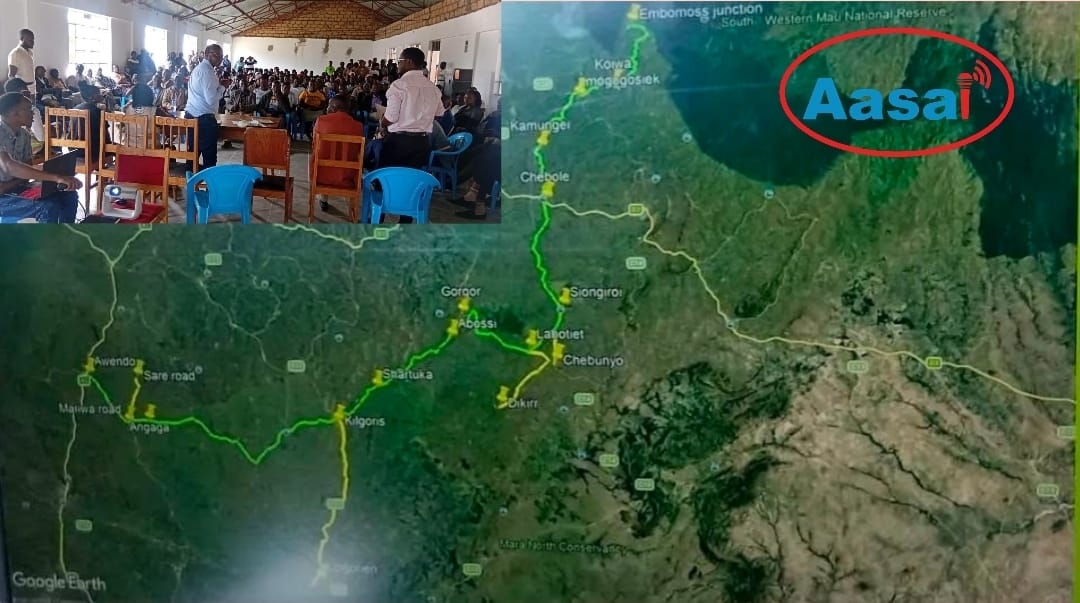
The proposed Chebole–Siongiroi–Labotiet–Kilgoris road upgrade has gained momentum following a public participation forum held yesterday at Siongiroi. The route, which connects the key centres of Chebole, Siongiroi, Labotiet and Kilgoris, was recently refilled with murram and is currently passable. Residents welcomed the improvement but continue to push for permanent construction and upgrading to enhance transport, trade, access to essential services and economic activities across the region.
Chebole–Kilgoris Road Gains Fresh Momentum as Public Participation Forum Opens Way for Major Upgrade
SIONGIROI, Bomet — The long-awaited improvement of the Chebole–Siongiroi–Labotiet–Kilgoris road has gained fresh momentum following a public participation forum held yesterday at Siongiroi, bringing residents and other stakeholders closer to the proposed construction and upgrading of the important regional transport corridor.
The forum marked an important stage in plans to improve the road, which links communities in Bomet and Narok counties and provides an important connection between Chebole, Siongiroi, Labotiet and Kilgoris. Residents have for years raised concerns over the condition of the road, particularly during rainy periods when some sections become difficult for motorists and public transport operators to navigate.
The latest public participation meeting provides an opportunity for local residents to give their views on the proposed works, raise concerns and contribute to decisions affecting the project.
The development also comes at a time when the road has received a temporary boost in its condition after sections were recently refilled with murram. The grading and placement of murram have made the road currently passable, easing movement for motorists, public service vehicles, motorcycles, traders and residents who depend on the route for their daily activities.
However, while the recent murram works have improved mobility, they are not a substitute for the comprehensive upgrading that residents have been seeking. The temporary improvement is expected to provide relief as the larger road development process moves forward.
The Chebole–Siongiroi–Labotiet–Kilgoris corridor has strategic importance because it connects rural communities to major trading centres and facilitates access to schools, health facilities, markets and other essential services. Improved road infrastructure would also make it easier for farmers to transport agricultural produce to markets while reducing travel time and vehicle operating costs.
Public participation marks key stage
The public participation forum at Siongiroi is significant because infrastructure projects of this scale require engagement with communities that will be directly affected by the works.
Residents' input can help identify areas requiring particular attention, including drainage, road alignment, access to homes and businesses, market centres and other community facilities along the route.
The forum also gives residents an opportunity to seek clarity on the scope of the proposed construction, the expected standards, implementation arrangements and timelines.
The proposed corridor is already part of a broader government road-development programme. In January 2026, the Kenya National Highways Authority (KeNHA) advertised consultancy services for feasibility studies and preliminary engineering design covering the wider Embomoss–Koiwa–Chebole–Siongiroi–Labotiet–Gorgor–Ambosi–Dikkir–Kilgoris–Enoosaen–Anganga–Mariwa road network.
The assignment covers approximately 143 kilometres and is being undertaken under the Roads for Rural Economic Development Project, supported by a World Bank grant. The consultancy includes feasibility studies, preliminary engineering design and engineering design for associated fibre-optic infrastructure. (Kenha)
This means the latest engagement at Siongiroi comes against the backdrop of a broader effort to examine and develop the road network connecting the region.
Temporary relief for motorists
For road users, the most immediate change is the improvement in passability following the recent application of murram.
Before the intervention, poor sections of the road could make travel difficult, especially where potholes, erosion and muddy surfaces affected movement. The fresh murram has provided a smoother and more usable surface in affected areas.
Motorists and motorcycle riders can therefore use the road with greater ease than before, although caution remains necessary because a murram surface is still vulnerable to deterioration from heavy traffic and rainfall.
Residents are expected to continue monitoring the road as they await the next stages of the proposed upgrade. The current condition provides a measure of relief, but the long-term solution will depend on proper engineering works, adequate drainage and construction to the required standard.
Government records show continued attention to the corridor
Government procurement records indicate that the road has been receiving attention within ongoing road-development programmes.
The Kenya Rural Roads Authority (KeRRA), for example, listed the rehabilitation of Chebole–Siongiroi–Labotiet–Chebunyo–Dikir among road projects under its 2026 procurement notices. The project appeared in several notices, including an entry marked for retendering. (Kerra)
The procurement history underscores the fact that the road's improvement has involved several stages and that implementation of major infrastructure projects can take time as authorities move through design, procurement and contracting processes.
For residents, however, the expectation remains straightforward: a reliable road that can be used throughout the year.
Economic importance
The Chebole–Kilgoris connection is more than a transport route. It serves communities whose livelihoods are closely tied to agriculture, livestock keeping, small businesses and trade.
A better road would allow farmers to move produce more efficiently, potentially reducing losses caused by delays and difficult road conditions. Traders would also be able to travel more reliably between market centres, while residents would have easier access to services outside their immediate communities.
Transport operators stand to benefit from improved road conditions through reduced vehicle maintenance costs and shorter journey times.
The road could also strengthen economic links between Bomet and Narok counties by making movement between the two regions easier.
For students and patients, the benefits could be equally significant. Better roads can improve access to schools and health facilities, particularly for people living in remote areas.
Residents await the next step
The public participation forum has now placed the views of residents on record and provided an important platform for engagement between communities and project stakeholders.
The immediate improvement through murram has also made the road usable while the broader plans progress. But residents are likely to judge the success of the process by what happens next: completion of the necessary technical work, procurement, mobilisation and eventual construction.
The government has already identified the wider corridor for feasibility studies and preliminary engineering design under the Roads for Rural Economic Development Project. (ICT Authority)
For residents along the Chebole–Siongiroi–Labotiet–Kilgoris route, the hope is that the current stage will translate into a durable road rather than another temporary intervention.
For now, the road is passable following the recent murram works, providing much-needed relief to road users. The bigger question, however, is when the proposed construction and upgrading will move from planning and consultation into full-scale implementation.
The Siongiroi public participation forum therefore represents both an important milestone and a reminder of the expectations that communities have placed on the project.
After years of dealing with difficult road conditions, residents want a road that is safe, reliable and usable in all seasons. The latest developments offer renewed optimism that the Chebole–Kilgoris connection could eventually receive the comprehensive improvement it requires.

You Might Also Like
-
Road safety is not the responsibility of drivers alone. Every person who uses the road has a role to play in preventing accidents and protecting lives. While drivers have the primary responsibility of ensuring that vehicles are operated safely and that traffic rules are followed, passengers also hav
-
President William Ruto has begun a two-day development tour of Narok County, with the visit expected to highlight the government’s efforts to accelerate development and address key priorities affecting residents. During the tour, the President is set to launch and inspect several projects focusing
-
IEBC Commissioner Ann Nderitu: University Degree Not Mandatory for Presidential, Gubernatorial or Parliamentary Candidates in 2027
-
Gachagua: Ruto’s Claim That He Cannot Work With Me Is Not About Willingness, But Because He Knows It Is Impossible.
-
Paul Ng’eno, the elder brother of the late Emurua Dikirr MP Johana Ng’eno, has died while receiving treatment at a hospital in Eldoret. He passed away on Friday evening, August 21, 2026, after his condition reportedly deteriorated.
-
Zambia’s President secures a second term in office with a decisive 61 percent majority vote



.png)