



Kajiado Aircraft Crash: Student Pilot and Instructor Killed in Tragic Training Flight at Kipeto
The fatal aircraft crash in Kipeto, Kajiado West, has left two people—a student pilot and a flight instructor—dead after the training aircraft went down near the Kipeto Wind Power Project. Preliminary reports have pointed to heavy morning mist and poor visibility as possible contributing factors, although the definitive cause remains subject to an official aviation investigation. Authorities are expected to examine the aircraft wreckage, weather conditions, flight path, maintenance records and the circumstances surrounding the reported emergency landing attempt. As investigations continue, the incident highlights the importance of aviation safety, proper weather assessment and rigorous pilot-training procedures while the families, colleagues and friends of the two victims mourn their loss.
A light aircraft operated by the Kenya School of Flying crashed in the Kipeto area of Kajiado West on Friday, September 18, 2026, killing the two people who were on board. The victims were identified in initial reports as a student pilot and a flight instructor, with police confirming that both occupants died following the accident. The crash occurred near the Kipeto Wind Power Project, an area characterized by open and hilly terrain.
The incident has attracted significant attention because the aircraft was reportedly conducting a routine training flight when it went down. Early reports initially provided limited information about the number of people aboard and the severity of the casualties, but subsequent police confirmation established that there were two occupants and that both had died.
What happened in Kipeto
The aircraft crashed in Kipeto, within Kajiado West Constituency, on the morning of September 18. According to reports citing Kajiado West police authorities, the aircraft was being used by the Kenya School of Flying for training purposes.
Citizen Digital reported that the aircraft came down near the Kipeto Wind Power Project during what was described as a routine training flight. Both the student pilot and the instructor died in the incident. Emergency responders and members of the local community moved toward the crash site after the accident was reported, but the two occupants could not be saved.
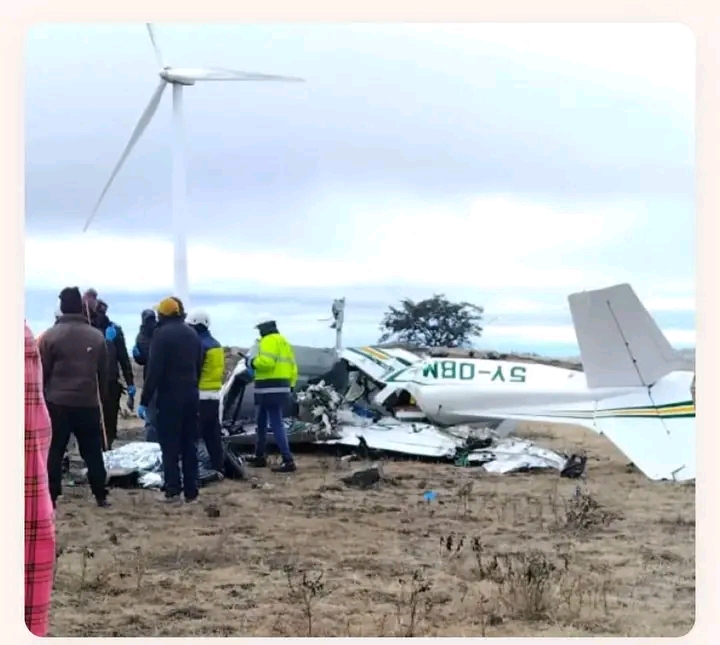
Other reports described the aircraft as a small or light aircraft and said the wreckage was found in an open field near the wind-power installation. Photographs from the scene showed extensive damage to the aircraft, with pieces of the wreckage scattered around the crash area.
The location of the crash is significant because the Kipeto area is known for its wind-power infrastructure and open landscape. The crash happened away from a major urban centre, meaning that residents and first responders in the area played an important role in the initial response.
Two people confirmed dead
The most serious development in the incident is the confirmation that both people aboard the aircraft died.
Kenyans.co.ke reported that the aircraft had two occupants—a student and a teacher—and that one victim died at the scene while the second succumbed to injuries while being taken to Kajiado Referral Hospital. The report attributed the information to Kajiado West Police Commander Maureen Kuto.
Citizen Digital similarly reported that both occupants had already succumbed to their injuries by the time emergency teams and residents reached the scene.
The deaths have turned what was initially reported as an aircraft accident with casualties feared into a confirmed fatal aviation accident involving two people.
Preliminary reports point to poor visibility
One of the most important details emerging from the early investigation concerns weather and visibility conditions.
According to preliminary information cited by Kenyans.co.ke, Kajiado West Police Commander Maureen Kuto said that heavy morning mist and poor visibility may have contributed to the crash. The report stated that the aircraft encountered the poor visibility and that an attempt was made to crash-land before the aircraft went down.
This information should, however, be treated as a preliminary account rather than the final determination of the cause.
Aircraft accidents are normally investigated in detail before an official cause is established. Weather conditions, aircraft condition, pilot actions, flight planning, mechanical systems, navigation, terrain, communications and other factors can all be examined during such investigations.
It would therefore be premature to conclude that poor visibility was definitively responsible for the crash until aviation investigators complete their work.
Emergency response at the scene
Following the crash, emergency responders and security personnel moved to the area. Local residents also gathered around the site as authorities began assessing what had happened.
Reports from the scene showed significant damage to the aircraft, with debris and other items scattered across the surrounding area. Emergency personnel were seen examining the wreckage and securing the accident scene.
Authorities also urged members of the public to stay away from the crash site and avoid touching or moving aircraft debris.
Such precautions are important because an aircraft crash scene can contain evidence that investigators need to establish what happened. Moving pieces of the aircraft, luggage or other material can potentially interfere with the reconstruction of the accident.
Investigation expected
The accident is expected to be investigated by Kenya's aviation accident investigation authorities.
The Aircraft Accident Investigation Department (AAID) is Kenya's national aircraft accident investigation agency. According to its official website, the department investigates aircraft accidents and serious incidents involving local and foreign aircraft in Kenya in accordance with international aviation investigation standards.
The AAID explains that the purpose of an accident investigation is to improve aviation safety and prevent similar accidents from happening again. Its investigations are not primarily intended to assign blame or liability.
Investigators will therefore be expected to examine the aircraft, flight circumstances, weather conditions, training activity and other relevant evidence.
The investigation may include examination of the wreckage, aircraft maintenance records, flight information, communications, witness accounts and other available evidence.
Why the investigation matters
Aircraft accidents involving training flights are particularly significant because flight schools are responsible for preparing pilots to operate safely under a wide range of circumstances.
A training flight normally involves an instructor supervising a student as the student develops flying skills. Depending on the stage of training, the student may be practicing takeoffs, landings, navigation, emergency procedures or other aspects of flight operations.
In this case, investigators will need to establish exactly what the aircraft and its occupants were doing immediately before the crash.
The circumstances surrounding the reported attempt to make an emergency or crash landing will also be important. Investigators may examine what caused the flight to become unsafe, how the crew responded and whether anything could have been done differently.
However, those questions cannot be answered reliably from preliminary reports alone.
Importance of weather conditions
The reported morning mist has emerged as an important part of the early account.
Visibility is a critical factor in aviation. Pilots need adequate visual information when operating under visual flight conditions, particularly during phases of flight close to the ground.
If visibility deteriorates unexpectedly, pilots may face challenges identifying terrain, obstacles, landmarks and suitable areas for an emergency landing.
However, the presence of mist does not automatically establish that weather caused an accident. Investigators would normally need to determine the actual visibility conditions, the aircraft's altitude, flight path, applicable operating rules and the decisions made by the crew.
This distinction is important because early information at an accident scene can change as investigators obtain additional evidence.
Kenya School of Flying connection
The aircraft has been reported as being operated by the Kenya School of Flying, one of Kenya's flight-training institutions.
The crash therefore raises questions about the circumstances under which the training flight was being conducted, although there is currently no basis in the available reports to attribute wrongdoing to the flight school.
A proper investigation will be needed before conclusions can be drawn about aircraft maintenance, operational procedures, training practices or any other potential factor.
It is also important to distinguish between an accident involving an individual aircraft and the safety record of an entire institution. A single accident does not by itself establish a systemic problem.
Scene near Kipeto Wind Power Project
The crash site near the Kipeto wind-power installation has also featured prominently in reports about the incident.
Kenyans.co.ke reported that the aircraft went down near a wind-power plant and that wreckage was scattered across an open field.
The location will likely be important to investigators as they reconstruct the aircraft's final movements.
Investigators may examine the terrain, the aircraft's direction of travel, the location and distribution of wreckage and any available witness accounts.
The fact that the crash occurred in an open area may also assist investigators in documenting the wreckage pattern and other evidence.
Authorities caution public against interfering with wreckage
Members of the public have been urged to keep away from the crash scene and not interfere with aircraft debris.
This is standard and important following aviation accidents. Aircraft wreckage can provide investigators with valuable information about the circumstances of an accident.
Kenya's AAID says accident wreckage should not simply be removed or recovered without authorization from the appropriate accident investigator. Its guidance notes that only an accident investigator can give permission for wreckage or an aircraft involved in an accident to be removed or recovered under the relevant regulations.
People who encounter such an accident should therefore leave the area to trained responders and investigators.
What remains unknown
Despite the confirmation of the two deaths, several details surrounding the crash remain subject to investigation.
Among the questions that investigators will need to answer are:
The precise aircraft type and registration.
The exact flight route and altitude before the crash.
The precise weather and visibility conditions.
What the student and instructor were doing immediately before the accident.
Whether the aircraft experienced any mechanical or technical problem.
Whether the aircraft was operating normally before the incident.
The exact sequence of events leading to the crash.
Whether the reported emergency landing attempt was made and under what circumstances.
Whether any other factors contributed to the accident.
These details should become clearer as authorities conduct their investigation.
Aviation safety questions
The Kajiado crash is likely to renew attention on aviation safety and pilot training in Kenya.
Flight training is an essential part of building Kenya's aviation workforce. Student pilots must learn to handle routine flying as well as challenging circumstances, including poor visibility and emergency situations.
At the same time, flight schools and aviation authorities have responsibilities relating to aircraft airworthiness, instructor qualifications, operational procedures, weather assessment and safety management.
The investigation will be important not only for determining what happened to the two people who died but also for identifying any safety lessons that could prevent similar incidents.
Kenya's AAID specifically states that its investigations are intended to enhance aviation safety and prevent recurrence of accidents.
A developing story
The Kajiado aircraft crash remains a developing story. Early reports evolved rapidly during the day—from initial reports of a small aircraft crash and feared casualties to confirmation that two occupants had died.
Because the investigation is still at an early stage, information about the cause should be treated cautiously.
The preliminary account concerning mist and poor visibility provides an important lead, but it should not be treated as the final finding. Aviation accident investigations can take considerable time because investigators must gather and analyze technical and operational evidence.
The AAID says that completed accident reports can take months or even years, depending on the complexity of an investigation.
For now, the central facts are that a light aircraft operated by the Kenya School of Flying crashed in Kipeto, Kajiado West, on September 18, 2026, during a reported training flight, and two people—a student pilot and an instructor—lost their lives. Police and emergency responders attended the scene, while aviation authorities are expected to establish the precise circumstances and cause of the accident.
The incident is a tragic reminder of the risks involved in aviation and the importance of thorough investigations after every serious accident. The findings from the investigation will be essential in understanding what happened and determining whether any additional safety measures are necessary across Kenya's flight-training sector.

You Might Also Like
-
Uhuru Kenyatta's appearance at the burial of Christine Waruguru Kariuki in Gikuu, Kiharu, was primarily a condolence event, but his closing words transformed the occasion into a major political talking point. After delivering a prepared message focused on the life of the deceased, Uhuru ended with t
-
President William Ruto's message today focused heavily on the responsibility of the police to protect Kenya's democratic space without becoming involved in partisan politics. Speaking during the passing-out parade of 1,273 GSU officers in Embakasi, he warned political leaders against involving secur
-
The inauguration of Kenya's counter-terrorism hotline on September 18, 2026, represents an effort to strengthen the connection between members of the public and security authorities. The new 0800 900 900 reporting line and accompanying online portal are intended to make it easier for Kenyans to shar
-
Deputy President Kithure Kindiki's September 17 visit to Maua was centred on the government's development agenda in Igembe South and the wider Meru County. His programme included inspection of the Sh100 million Nyambene Hospital expansion, the Maua Modern Market, and updates on larger countywide pro
-
The arrest of five factory clerks in Bureti over alleged falsification of tea-weighing scales has placed renewed focus on transparency and accountability in Kenya's tea industry. The operation followed complaints from farmers and was conducted by a multi-agency team involving the Tea Board of Kenya
-
A deadly fuel tanker accident near Paul Boit Secondary School in Turbo, Uasin Gishu County, has left at least two people dead and several others injured after an overturned petroleum tanker caught fire and exploded. The incident occurred along the busy Eldoret–Webuye highway after fuel reportedly