



“Ni Hayo Machache Kutoka Sponyo!” — Uhuru Kenyatta’s Surprise Sign-Off Sparks Laughter and Political Buzz
Uhuru Kenyatta's appearance at the burial of Christine Waruguru Kariuki in Gikuu, Kiharu, was primarily a condolence event, but his closing words transformed the occasion into a major political talking point. After delivering a prepared message focused on the life of the deceased, Uhuru ended with the unexpected phrase “Ni hayo machache kutoka Sponyo”, referring to the nickname that has recently featured in political exchanges involving President William Ruto and his allies. The remark drew laughter from mourners and was widely interpreted as Uhuru acknowledging the nickname in a light-hearted manner. The episode comes at a politically significant moment, with renewed exchanges between Uhuru and Ruto, debates over Uhuru's continued political influence, and changes expected within the Jubilee Party following a recent court ruling. While the former president did not deliver a major political attack during the funeral, his brief “Sponyo” sign-off demonstrated how even a few words from him can attract substantial national attention. At the same time, the circulation of fabricated quotes allegedly attributed to Uhuru shows the importance of relying on verified reports when following rapidly developing political stories.
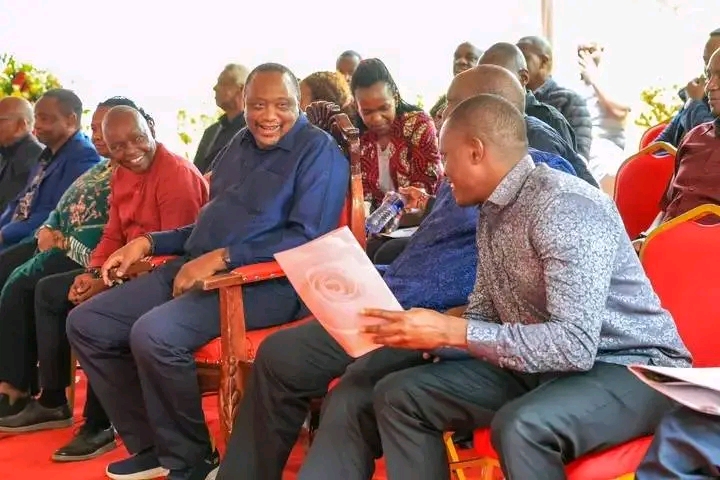
Former President Uhuru Kenyatta made headlines on Friday, September 18, 2026, after appearing to embrace the nickname “Sponyo”, a term that has recently been used by President William Ruto and his allies in political exchanges involving the retired president. Uhuru used the phrase “Ni hayo machache kutoka Sponyo” at the end of his remarks during the burial of Christine Waruguru Kariuki in Gikuu, Kiharu Constituency, Murang’a County. His unexpected closing line attracted laughter from mourners and quickly became one of the most discussed moments of the event.
Uhuru attended a funeral in Murang’a
Uhuru was in Gikuu, Kiharu Constituency, for the burial of Christine Waruguru Kariuki, popularly known as Maito. Waruguru was the mother of former State House Comptroller George Kariuki.
Rather than use the occasion for a major political speech, Uhuru largely concentrated on condoling with the family and remembering the life of the deceased. Reports indicate that he described Waruguru as belonging to a generation of Kenyan women whose contributions to their families and communities were not always adequately recognised.
He highlighted her resilience, hard work and entrepreneurial efforts, including her efforts to establish businesses and develop homes in Karen. His message therefore focused largely on family, motherhood, sacrifice and the contribution of older Kenyan women to society.
The funeral was attended by several prominent political figures, including former Interior Cabinet Secretary Fred Matiang’i and Kiharu MP Ndindi Nyoro. Their presence added political interest to an event that otherwise centred on mourning and family.
Why Uhuru chose to read a prepared speech
One of the notable parts of Uhuru's remarks came before he began reading his condolence message.
The former president explained that he normally speaks spontaneously, but decided to prepare his remarks because of concerns that statements made off the cuff could be interpreted differently or misrepresented.
According to reports, Uhuru said that he usually speaks off the cuff but that “these days life is becoming quite dangerous,” prompting him to decide to read his prepared remarks rather than speak freely.
The comment was significant because Uhuru has increasingly become the subject of political debate over his alleged involvement in opposition politics. President Ruto and his allies have accused the retired president of supporting or financing opposition activities, claims that Uhuru has not accepted as presented by his political opponents.
By choosing prepared remarks, Uhuru avoided turning the funeral into a lengthy political confrontation. His written message remained focused primarily on the deceased and her family.
The moment that caught everyone's attention
After delivering his condolence message, Uhuru changed the tone of his closing remarks.
He ended by saying:
“Ni hayo machache kutoka Sponyo…”
He then added that they would meet again and continue working together.
The phrase generated laughter among mourners and immediately attracted attention because “Sponyo” has become associated with recent political exchanges between Uhuru and Ruto.
The nickname is understood as a shortened or altered form of “sponsor.” It has been used in political rhetoric surrounding claims that Uhuru is sponsoring or supporting opposition activities. Uhuru's decision to use the nickname himself therefore gave the phrase a different dimension.
Rather than directly launching an attack on Ruto, Uhuru appeared to turn the nickname into a light-hearted reference during his closing remarks.
It is important to distinguish the documented remark from interpretations about his intention. News reports describe the moment as light-hearted and as an apparent acknowledgement of the nickname, but Uhuru did not use the occasion to give a detailed explanation of what he meant by the phrase.
The background to the “Sponyo” nickname
The phrase has emerged within a broader political disagreement between Ruto and his predecessor.
Ruto and his supporters have recently accused Uhuru of being involved in opposition political activities. The debate has become more prominent as political parties and leaders position themselves ahead of the 2027 General Election.
The two men once worked closely together. They were elected on the Jubilee Party ticket in both the 2013 and 2017 elections, serving as President and Deputy President respectively. Their political relationship later deteriorated during Uhuru's second term.
Ruto eventually succeeded Uhuru as president after winning the 2022 presidential election.
Since leaving State House, Uhuru has generally maintained a lower public profile than he had while president. However, his continued involvement in political discussions has ensured that he remains an important figure in Kenya's political conversation.
Recent comments by Ruto about Uhuru have further increased attention surrounding the former president.
Uhuru's remarks come after fresh political attacks
The “Sponyo” moment happened against the backdrop of increasingly sharp political exchanges.
Ruto recently referred to Uhuru as a “rebel leader” while discussing his former boss's alleged involvement in opposition politics. The remarks generated reactions from opposition figures, including Fred Matiang’i.
Matiang’i argued that lawful opposition activity and criticism of the government should not be described as rebellion. He maintained that political parties and opposition figures have a legitimate role in scrutinising the government.
The exchange illustrates how Uhuru's political legacy continues to feature prominently in the political debate even though he is no longer Kenya's sitting president.
Uhuru's Jubilee leadership also remains an issue
Another development involving Uhuru this week has been his position within the Jubilee Party.
A recent High Court ruling dealt with the ability of retired presidents to hold formal positions in political parties beyond the period permitted by law. Jubilee subsequently said it respected the ruling and would align itself with the court's decision.
Uhuru has indicated his willingness to facilitate the transition of Jubilee leadership following the ruling.
This has triggered discussions within Jubilee about who should succeed him as party leader. Several politicians have already started discussing the future leadership of the party.
Former Nyeri Town MP Ngunjiri Wambugu has argued that the party should follow its constitutional procedures and allow the National Delegates Convention to determine the next leader.
The leadership question is particularly important because Jubilee was the dominant political vehicle through which Uhuru and Ruto won the 2013 and 2017 elections.
Political figures who attended the burial
The presence of other political leaders at the funeral also generated interest.
Fred Matiang’i attended the event. He is currently involved in opposition politics and has been identified as Jubilee's presidential candidate for the 2027 election by reports covering his political activities.
Ndindi Nyoro, the Kiharu MP and leader of the People's Party of Kenya, was also present.
Nyoro has recently been vocal about the treatment of Uhuru. On Thursday, September 17, he urged Ruto to respect the retired president and argued that Ruto's political opponent should not be Uhuru Kenyatta.
His appearance alongside Uhuru and Matiang’i consequently gave the funeral additional political significance, although Uhuru himself did not turn the event into a political rally.
Why the remark is significant
The significance of “Ni hayo machache kutoka Sponyo” lies partly in the fact that Uhuru used a nickname associated with political criticism against him.
Instead of avoiding the word, he incorporated it into his own closing statement.
That can be described as an example of a political figure taking a term used by opponents and using it in a humorous context. However, the exact intention behind the remark should not be overstated. Uhuru did not provide a lengthy explanation of the nickname, nor did he use the closing statement to confirm the allegations that have been made against him.
The documented fact is that he used the phrase, and the audience responded with laughter.
Uhuru avoided a major political confrontation
Another important feature of today's remarks is what Uhuru did not say.
Despite the increasingly heated political exchanges surrounding his name, he did not use the funeral to deliver a lengthy attack against Ruto.
Instead, the former president concentrated on the deceased, her family and the wider contribution of mothers to Kenyan society.
His only notable political reference came through the humorous “Sponyo” sign-off.
This was consistent with his earlier explanation that he had prepared his remarks because he was concerned about his words being interpreted or reported in ways he did not intend.
A warning about fake Uhuru quotes
The increased public attention surrounding Uhuru's remarks has also created an environment where unverified statements attributed to him can spread quickly online.
On September 18, Africa Check reported that social-media graphics claiming Uhuru had said Fred Matiang’i could not lead Kenya were fabricated. The fact-checking organisation said it found no evidence that Uhuru made the alleged statement and traced the graphic to a Facebook page it described as unreliable.
This is important when following political developments involving prominent figures. Statements should be distinguished between what was actually said in a verified speech or reported by established news organisations and claims circulating through social media.
In today's case, the “Sponyo” remark has been independently reported by multiple Kenyan media outlets, including People Daily and Capital FM.
The wider 2027 political context
Uhuru's remarks come at a time when Kenya's political environment is already becoming increasingly focused on the 2027 General Election.
Ruto is seeking another term, while opposition parties and political figures are working on alliances, leadership structures and possible presidential campaigns.
The former president's name continues to appear in these discussions because of his previous influence within Jubilee and his relationships with several politicians now involved in opposition politics.
At the same time, the recent court ruling concerning retired presidents and formal political-party leadership has created a new question about the precise role Uhuru will play going forward.
Jubilee has stressed that the court ruling concerns formal party office and does not, according to the party's interpretation, prevent retired presidents from being members of political parties or participating in political activities within the law.
This means that Uhuru's departure from a formal party leadership position does not automatically remove him from Kenya's wider political conversation.

You Might Also Like
-
Deputy President Kithure Kindiki's September 18, 2026 visit to Mwea brought together development, agriculture and politics. He officially opened the Mwea Huduma Centre, which will also host a Jitume ICT Hub, inspected the nearly completed Kangiciri-Karira Hospital-Ngurubani Road, highlighted the Sh5
-
Kenya is heading into the weekend with mixed weather conditions: rain is possible in several western, Rift Valley, central, Nairobi and coastal areas, while much of the north and northeast is likely to remain warmer and relatively drier. Residents should remain alert to localized showers and thunder
-
President William Ruto's message today focused heavily on the responsibility of the police to protect Kenya's democratic space without becoming involved in partisan politics. Speaking during the passing-out parade of 1,273 GSU officers in Embakasi, he warned political leaders against involving secur
-
The fatal aircraft crash in Kipeto, Kajiado West, has left two people—a student pilot and a flight instructor—dead after the training aircraft went down near the Kipeto Wind Power Project. Preliminary reports have pointed to heavy morning mist and poor visibility as possible contributing factors
-
The inauguration of Kenya's counter-terrorism hotline on September 18, 2026, represents an effort to strengthen the connection between members of the public and security authorities. The new 0800 900 900 reporting line and accompanying online portal are intended to make it easier for Kenyans to shar
-
Deputy President Kithure Kindiki's September 17 visit to Maua was centred on the government's development agenda in Igembe South and the wider Meru County. His programme included inspection of the Sh100 million Nyambene Hospital expansion, the Maua Modern Market, and updates on larger countywide pro