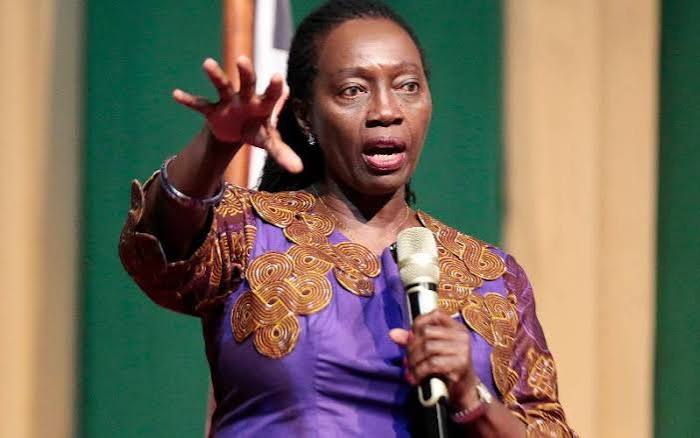
MARTHA KARUA CALLS FOR RESPECT WITHIN UNITED OPPOSITION, SAYS EVERY LEADER HAS A CHANCE TO FLY PRESIDENTIAL FLAG
People's Liberation Party (PLP) leader Martha Karua has called for mutual respect, unity and political tolerance among leaders within the United Opposition as preparations for the 2027 General Election gather momentum. Karua has insisted that every leader in the coalition has an equal opportunity to secure the presidential ticket to challenge President William Ruto, warning against treating any individual as the automatic flag-bearer. Her remarks come amid growing political discussions and competing presidential ambitions within the opposition, raising questions about how the coalition will manage internal competition while maintaining a united front. She has emphasised the importance of fairness, consultations and an inclusive nomination process that allows all interested leaders to present their ambitions without unnecessary confrontations.
People's Liberation Party (PLP) leader Martha Karua has called on leaders within the United Opposition to demonstrate mutual respect and embrace political tolerance as they prepare for the 2027 General Election. Karua has maintained that every leader within the opposition coalition deserves an equal opportunity to pursue the presidential ticket, insisting that no individual should be considered the automatic flag-bearer in the race to challenge President William Ruto.
Her remarks come amid growing political discussions surrounding the future of the opposition and the process through which the coalition will identify a presidential candidate ahead of the next General Election. With several political leaders expressing interest in the country's top political seat, questions have emerged over how the alliance intends to manage competing ambitions while maintaining unity.
Karua's position highlights the importance of creating an environment where all leaders can freely express their political aspirations without facing intimidation, hostility or unnecessary criticism from fellow members. She believes that respect should remain central to the coalition's operations, particularly at a time when political parties and their leaders are working towards building a common political platform.
The PLP leader's comments also reflect the challenges facing opposition formations whenever several influential politicians seek to occupy the same political position. While leaders may share common interests and agree on the need to challenge the sitting administration, their individual ambitions can sometimes create disagreements over leadership, strategy and the direction of the coalition.
The United Opposition brings together leaders from different political backgrounds, parties and regions, with each member having a distinct political history and support base. Such diversity presents an opportunity for the coalition to broaden its national appeal, but it also requires effective consultations and clear mechanisms for resolving disagreements.
Karua's appeal for respect therefore comes at a time when political discussions within the opposition are increasingly focusing on the question of who should eventually carry the coalition's presidential ticket.
Several leaders have previously expressed their willingness to contest for the presidency, while others have maintained that the opposition must first establish a united political front before settling on an individual candidate.
The competition for the presidential ticket is expected to become a major issue as the 2027 General Election approaches. However, Karua's position suggests that the process should be guided by fairness, consultation and recognition of the political interests of all participating leaders.
She has maintained that every member should be allowed to present their case and demonstrate their ability to lead without being dismissed because of their political background or position within the coalition.
The question of presidential candidature remains one of the most sensitive matters for opposition leaders, considering that their ability to agree on a common candidate could shape the direction of their political engagement ahead of the election.
For a coalition seeking to challenge an incumbent administration, maintaining internal stability is an important part of the political process. Disagreements over leadership positions and political strategy can create divisions if they are not addressed through structured discussions and negotiations.
Karua's message appears to place emphasis on the need for leaders to separate their personal political ambitions from the broader objectives of the opposition movement. She has called for an approach in which political differences are handled through dialogue rather than public confrontations that could undermine relationships among coalition partners.
The PLP leader's remarks also raise questions about how the United Opposition intends to establish a transparent and acceptable process for selecting its presidential candidate. Such a process would need to accommodate the interests of different parties while ensuring that the eventual decision is supported by the coalition's membership.
The opposition has several political figures with national ambitions and established political constituencies. Their participation could influence discussions surrounding the coalition's leadership structure, campaign strategy and approach to the 2027 presidential contest.
Among the issues likely to dominate these discussions is whether the coalition will conduct a formal nomination process, negotiate a consensus candidate or adopt another mechanism acceptable to all participating parties.
Whatever approach is eventually adopted, Karua's call suggests that respect for individual political ambitions should remain a priority throughout the negotiations.
The former presidential candidate has been involved in Kenya's political affairs for several years and has consistently participated in discussions concerning opposition unity, democratic accountability and political leadership.
Her position within the opposition gives her an opportunity to contribute to conversations about how different political formations can work together despite their competing interests.
The PLP leader's remarks also come against the backdrop of wider efforts by opposition politicians to organise themselves ahead of the next General Election. Leaders have been holding consultations, making public statements and exploring possible political arrangements as they seek to establish a common position.
The coalition's ability to manage these conversations could become an important factor in determining its organisational direction.
Political observers have frequently pointed to the difficulties that arise when opposition parties attempt to unite around a common candidate. Although parties may agree on certain national issues, disagreements can emerge when discussions shift towards sharing political responsibilities and deciding who should lead the alliance.
Such challenges are not unique to Kenya, as political coalitions in different countries have often faced difficult negotiations when several leaders seek the same position.
In Kenya, the presidential contest carries significant political weight, making the process of selecting a flag-bearer particularly important for parties seeking to form a broad alliance.
The United Opposition will therefore need to balance the interests of individual leaders with the need to maintain a coordinated political structure.
Karua's emphasis on equal opportunity could also encourage more inclusive discussions within the coalition, allowing leaders from different political parties to participate without feeling that decisions have already been made by a small group.
For smaller parties within the alliance, recognition and respect could be particularly important in maintaining their commitment to the coalition. Their participation may contribute to the broader political arrangements being developed ahead of the election.
At the same time, larger political formations and leaders with established national profiles may have their own expectations regarding the coalition's leadership and presidential strategy.
Reconciling these interests will require political negotiations and a willingness among the leaders to accommodate different viewpoints.
Karua's remarks also underline the importance of avoiding personal attacks during internal political discussions. Public disagreements between coalition members can attract attention and create uncertainty about the stability of their political partnership.
A respectful political environment would allow leaders to compete for positions while continuing to cooperate on issues where they share common interests.
The opposition's focus on the 2027 General Election has also increased public attention on the question of whether the different political formations can maintain a united front throughout the campaign period.
The coalition's supporters will be interested in understanding how its leadership intends to resolve competing ambitions and whether all participating parties will agree to support the eventual presidential candidate.
For Karua, the starting point should be respect, fairness and recognition that every leader has a right to pursue their political ambitions.
Her position does not necessarily mean that every leader will eventually secure the presidential ticket. Rather, it places emphasis on ensuring that the process leading to the selection of a candidate is open to participation and acceptable to the coalition's members.
As political realignments continue ahead of the 2027 General Election, the United Opposition faces the task of building a common political strategy while managing the different interests represented within its ranks.
The coming months are likely to provide a clearer picture of how the coalition intends to approach the presidential nomination question and whether its leaders can agree on a framework that accommodates their ambitions.
Karua's latest remarks have therefore added to the ongoing conversation about opposition unity, internal democracy and the need for mutual respect among political leaders.
With several politicians potentially interested in the presidential ticket, the coalition's ability to manage competition without allowing it to develop into serious divisions will remain an important issue.
The PLP leader has maintained that no individual should be treated as the automatic presidential candidate, stressing that every leader deserves an opportunity to make their case.

You Might Also Like
-
A heartbreaking incident has been reported in Morogo, Chemaner, Bomet East, where a middle-aged man identified as Nicholas Rop has been arrested over allegations that he killed his two children, aged four and seven, before attempting to take his own life. The suspect is accused of slitting the throa
-
 Interior Cabinet Secretary Kipchumba Murkomen has urged opposition leaders to respect the Independent Electoral and Boundaries Commission (IEBC) and other independent institutions as Kenya prepares for the 2027 General Election. Murkomen has cautioned political leaders against making statements and
-
Police have arrested a suspect accused of assaulting officers during Mashujaa Day celebrations at Githongo Stadium in Imenti Central, Meru County. The arrest follows an incident that reportedly disrupted the national celebrations, prompting security agencies to investigate the circumstances surround
-
President William Ruto has arrived in Oyo, Republic of the Congo, ahead of a high-level four-nation summit expected to bring together key African leaders, including Democratic Republic of Congo President Félix Tshisekedi. The meeting comes amid strained diplomatic relations between Nairobi and Kins
-
German Federal President Frank-Walter Steinmeier is expected to arrive in Kenya on November 25–26, 2026, for a two-day official visit that will include high-level bilateral talks with President William Ruto at State House. The visit is expected to strengthen diplomatic relations between Kenya and
-
President William Ruto has renewed his criticism of opposition leaders who walked out of a consultative meeting with the Independent Electoral and Boundaries Commission (IEBC), accusing them of transferring their frustrations over disagreements on who should lead their presidential campaign to the e