



Politrack Poll Shows Growing Openness to Kenya’s First Female Deputy President
The survey indicates that 52% of respondents support the idea. Among those open to a female Deputy President, Kirinyaga Governor Anne Waiguru leads with 36%, followed by former Deputy President candidate Martha Karua at 27% and Homa Bay Governor Gladys Wanga at 15%.
A new national opinion survey has revealed growing openness among Kenyans to the possibility of the country having its first female Deputy President, as political discussions intensify ahead of the 2027 General Election.
The Politrack Africa survey, released on October 1, 2026, indicates that more than half of the respondents expressed some level of readiness to see a woman occupy the country’s second-highest executive office.
According to the findings, 16 percent of respondents said they were “very ready” for Kenya to have its first female Deputy President, while another 36 percent said they were “somewhat ready.” Politrack’s published reporting gives the combined readiness figure at about 53 percent, although the individual figures reported in some accounts produce a slightly different total.
The findings come at a time when the question of women occupying senior positions in Kenya’s executive leadership has become increasingly prominent. The 2022 General Election brought the issue into sharper focus after Martha Karua became the first woman to be selected as the running mate of one of the two major presidential contenders, when she joined Raila Odinga’s presidential ticket.
Although the ticket did not win the election, Karua’s nomination marked a significant moment in Kenya’s political history and demonstrated the growing presence of women in national political leadership.
The latest Politrack survey suggests that the conversation has continued to evolve, with a significant proportion of respondents indicating that they are open to seeing a woman serve as Deputy President.
However, the poll also shows that the country remains divided on the question.
Twenty-seven percent of respondents said they were “not very ready” for a female Deputy President, while another 21 percent said they were “not at all ready.” This means that although a substantial proportion of respondents are open to the idea, there remains a considerable section of the population that is either hesitant or opposed to the possibility.
The survey therefore provides a snapshot of public attitudes rather than a definitive indication of what will happen in the 2027 presidential election.
Waiguru Leads Among Female Figures
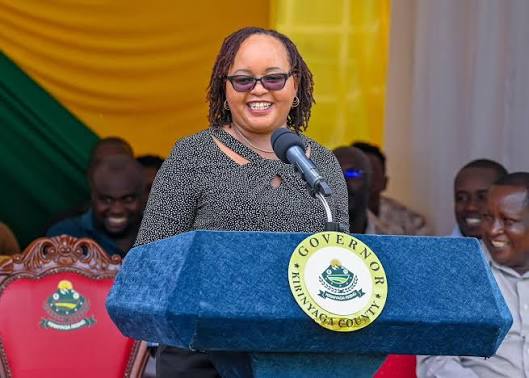
Among respondents who were open to the possibility of a female Deputy President and were asked to identify their preferred woman for the position, Kirinyaga Governor Anne Waiguru emerged with the highest share.
Waiguru received 36 percent, followed by former Justice Minister and People’s Liberation Party leader Martha Karua at 27 percent. Homa Bay Governor Gladys Wanga came third with 15 percent.
Other respondents either declined to name a preferred candidate or said they were not sufficiently familiar with the women included in the question. According to the reported figures, nine percent declined to state their preference, while seven percent said they did not know enough about the candidates to make a choice. Other candidates accounted for six percent.
The results place three prominent Kenyan women at the centre of the latest debate over the possibility of a female Deputy President.
Waiguru has served as Governor of Kirinyaga and has previously held senior national government positions. Her public profile has remained significant in national political discussions, particularly as political parties and leaders position themselves ahead of the 2027 elections.
Karua, meanwhile, remains one of Kenya’s most prominent female political figures. Her role as Raila Odinga’s running mate in the 2022 presidential election made her the first woman to appear on the presidential ticket of one of the two leading contenders in a Kenyan presidential election.
Gladys Wanga, the Governor of Homa Bay, has also established herself as an influential figure in national and regional politics.
Survey Covers All 47 Counties
Politrack Africa says the survey was conducted between September 15 and September 25, 2026, using a text-based technology platform that invited selected respondents to participate and answer the questions at their convenience.
A total of 20,419 respondents took part in the survey, with participants drawn from all 47 counties.
The research organisation said the national results were weighted according to each county’s share of the registered-voter population. The registered-voter population used for the weighting was reported at 22,102,532.
Politrack gave the survey a 95 percent confidence level and a margin of error of plus or minus three percentage points.
As with any opinion poll, the results represent public sentiment during the period when the survey was conducted. Political preferences can change as parties nominate candidates, alliances are formed, campaigns begin and voters receive more information about potential candidates.
Gender and Political Leadership
The findings also add to a longer-running national discussion about women and political leadership in Kenya.
Women have occupied several senior political positions in the country, including Cabinet positions, governorships, parliamentary leadership roles and other influential offices. However, Kenya has yet to have a woman serve as President or Deputy President.
The possibility of a female Deputy President has therefore become an important part of discussions surrounding the 2027 political landscape.
The latest poll does not establish that any particular woman will be selected as a running mate. Instead, it measures how respondents view the broader idea of having a woman in the position and, among those open to the idea, which female political figures they would prefer.
The distinction is important because the actual selection of a running mate will depend on political parties, presidential candidates, coalition negotiations and other factors that cannot be determined by an opinion poll alone.
What the Numbers Show
The survey provides several notable points about public opinion.
First, more than half of respondents expressed at least some level of openness to the idea of a female Deputy President. Second, the responses show that Anne Waiguru, Martha Karua and Gladys Wanga are among the female political figures attracting attention in the question.
Third, a sizeable section of respondents remains hesitant. The 27 percent who said they were “not very ready” and the 21 percent who said they were “not at all ready” demonstrate that the idea does not command universal acceptance.
The poll therefore reflects a country engaged in an ongoing debate about political leadership, gender representation and the direction of the 2027 presidential contest.
For now, the findings remain a measure of public opinion collected between September 15 and September 25. They should not be interpreted as an election result or as a prediction of who will become Deputy President after the 2027 General Election.
As political parties continue their preparations and potential presidential candidates consider their running mates, the question of whether Kenya is ready for its first female Deputy President is likely to remain part of the national conversation.
The Politrack findings indicate that a significant share of Kenyans is open to that possibility, while another substantial group remains undecided or opposed.
With the 2027 General Election approaching, the debate over who could occupy the Deputy President’s office—and whether the country will ultimately make history by electing its first woman to the position—will continue to attract public attention.

You Might Also Like
-
Health CS Aden Duale says the Ministry of Health has extended the HMIS transition period by one month, giving Level 5 and 6, private and faith-based facilities more time to complete the migration while ensuring uninterrupted healthcare services.
-
The St. Kizito Litein School for the Deaf eight-kilometre awareness walk gave students and teachers an opportunity to take their message beyond the school compound and into the streets of Litein. The October 1, 2026 activity was aimed at raising awareness about hearing impairment while promoting gre
-
Murkomen's presence in Kiminini and now Saboti places attention on several issues affecting residents of Trans Nzoia: roads and bridges, agricultural development, youth training, public services, security and cooperation between national and county governments. While the exact list of projects he ha
-
The Ogiek meeting in Nandi brought together members of a community that is geographically dispersed across several parts of the Rift Valley, including Kericho, Uasin Gishu and Nandi itself. The gathering came at a time when Ogiek communities continue to discuss ancestral land, historical displacemen
-
President Ruto's current Coast programme is therefore broader than a single-day project launch in Mombasa. It combines land titling, port and maritime development, railway connectivity, Dongo Kundu SEZ, water infrastructure, affordable housing, electricity expansion and regional trade. Mombasa's pos
-
The Senate Education Committee has directed the Inspector General of Police to issue an arrest warrant for Tharaka Nithi Governor Muthomi Njuki over his repeated failure to honour summonses since March 2026.