President Ruto Meets president Putin in Moscow as Kenya and Russia Move to Establish Economic Cooperation Commission in Major Trade and Investment Deal
President William Ruto's meeting with Russian President Vladimir Putin in Moscow represents an important development in Kenya's efforts to strengthen international economic partnerships. The signing of five memorandums of understanding, including one focusing on economic cooperation, provides a new foundation for expanding relations between the two countries. The discussions covered infrastructure investment, fertiliser manufacturing, agriculture, education, technology, trade and industrial development. Putin's announcement of 70 scholarships for Kenyan students and the reported growth in bilateral trade further demonstrate the potential areas of cooperation. For Kenya, the main objective is to attract investments that can strengthen local industries, create employment, increase exports and support long-term economic development.
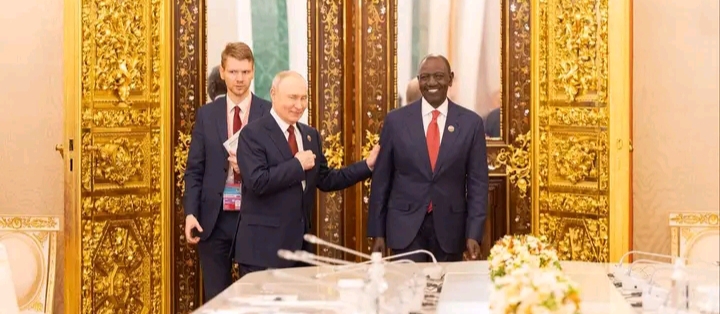
Kenya and Russia have taken an important step towards strengthening their economic and diplomatic relations following a high-level meeting between President William Ruto and Russian President Vladimir Putin in Moscow. The two leaders discussed ways of expanding trade, attracting investment, strengthening industrial development and creating new opportunities for cooperation between their countries.
The meeting, held on Thursday, October 29, 2026, on the sidelines of the Third Russia-Africa Summit and Economic and Humanitarian Forum, marked an important moment in Kenya's efforts to expand its international economic partnerships.
One of the major developments from the engagement was the signing of five memorandums of understanding between Kenya and Russia. President Ruto announced that one of the agreements specifically focused on economic cooperation, providing a framework for expanding commercial relations and creating further opportunities for businesses in both countries. The discussions came at a time when Kenya is looking for new international markets for its agricultural products and opportunities to attract foreign investment into major development projects.
Russia, on the other hand, has continued to express interest in strengthening its economic engagement with African countries, particularly in agriculture, energy, technology, infrastructure and industrial development.
The two leaders recognised the importance of building partnerships that deliver practical benefits rather than relying exclusively on diplomatic engagements and agreements.President Ruto confirmed that the agreements were intended to provide new opportunities for cooperation between the two countries.
The economic cooperation memorandum is particularly important because it provides a foundation for strengthening bilateral economic engagement.
The move towards a more structured economic cooperation mechanism could make it easier for Kenya and Russia to coordinate their priorities, identify investment opportunities and follow up on agreements reached by their governments.
Such a framework would also provide an opportunity for officials from both countries to address challenges affecting businesses, trade and investment.Kenya is seeking substantial resources to finance infrastructure development over the coming years as the government works to improve transportation, expand economic activities and strengthen connectivity between different regions.
The President explained that Kenya had established a National Infrastructure Fund to provide opportunities for public and private investment.
The fund is expected to support the mobilisation of resources for major development projects while creating opportunities for international investors to participate in infrastructure development.
Russia has experience in engineering, transport infrastructure, industrial development and energy. Kenya hopes that cooperation with Russian companies could bring additional technical expertise, investment capital and modern technologies into the country.Improved infrastructure would also support businesses by reducing transportation costs, improving the movement of goods and connecting producers to local and international markets.
The Port of Mombasa is particularly important because it serves Kenya and several neighbouring landlocked countries. Investment in its expansion and modernisation could strengthen its position as a major regional trade gateway.
The proposed cooperation could therefore have benefits extending beyond Kenya's borders. Kenya depends on agriculture as one of its most important economic sectors, with millions of households relying on farming for their livelihoods.
The sector also contributes significantly to exports through products such as tea, coffee, flowers, fruits and vegetables.
However, farmers continue to face challenges associated with production costs, agricultural inputs, unpredictable weather conditions and access to modern farming technologies.
President Ruto proposed that Kenya and Russia explore the possibility of establishing fertiliser production facilities in Kenya with the participation of Russian companies.
The proposal could involve localising Russian fertiliser production or establishing joint ventures between Kenyan and Russian businesses.
Such an arrangement could help Kenya strengthen its local manufacturing capacity and reduce dependence on imported agricultural inputs.It could also create employment opportunities for Kenyans through the construction and operation of production facilities.
Russia has significant experience in agricultural production and fertiliser manufacturing, making it a potential partner in efforts to strengthen Kenya's agricultural value chain.
The proposed cooperation could also extend to agricultural machinery, irrigation systems, food processing and modern farming technologies.
For Kenyan farmers, the most important outcome would be access to affordable and reliable agricultural inputs that improve productivity and increase household incomes.
Nevertheless, the proposed fertiliser investment will require further negotiations, financing arrangements and appropriate regulatory and environmental assessments before implementation. The development demonstrates the potential for expanding commercial relations between the two countries.
Kenya exports several agricultural products to international markets, including tea, coffee, fresh produce and cut flowers.
Russia presents an additional market that Kenyan exporters could explore to increase sales and diversify their international trading destinations.
However, the relationship has experienced a considerable trade imbalance, with Kenya importing more goods from Russia than it exports.
During the Russia-Kenya Business Roundtable on October 28, President Ruto disclosed that bilateral trade stood at approximately $380 million in 2025.
Kenya's exports were valued at approximately $52 million, while imports from Russia amounted to approximately $330 million.Kenyan exports mainly included tea, coffee, flowers, fruits and vegetables. Meanwhile, imports from Russia included wheat, fertilisers, iron and steel products.
Russian investment in Kenya was estimated at approximately $22 million.
These figures demonstrate why the Kenyan government wants to expand local production and attract more Russian companies into the country.
The government is particularly interested in partnerships that will enable Kenyan businesses to manufacture products locally rather than continue importing finished goods.
Ruto has challenged Russian investors to establish production facilities in Kenya and use the country as a gateway to the wider African market. The scholarships could provide additional opportunities for Kenyan students interested in acquiring specialised knowledge and professional qualifications.
International education partnerships are important because they expose students to different academic environments, research facilities and technological developments.
Kenya could benefit from stronger academic relations with Russia through student exchanges, research partnerships and collaboration between universities.
The opportunities could also support the development of skilled professionals in areas that are important to the country's economic transformation.
For Kenyan students, the announcement provides an opportunity to explore further education in Russia.Energy, technology and innovation
Energy and technology were also identified as important areas for stronger cooperation.
Russia has experience in energy development, engineering, industrial production and scientific research.
Kenya, meanwhile, is seeking investment and technology that can support its expanding economy and improve the country's productive capacity.
The two countries could explore opportunities in renewable energy, electricity infrastructure, engineering and industrial technology.
Kenya has invested considerably in geothermal, wind and solar energy as part of its efforts to expand electricity generation and support sustainable economic development.The two countries established diplomatic relations in 1963, shortly after Kenya gained independence.
Over the years, they have maintained diplomatic engagement through government representatives, international forums and other bilateral platforms.
Putin highlighted the importance of continued political dialogue and cooperation between the two countries.
He also recognised Kenya's contribution to the United Nations, particularly Nairobi's role as host of the United Nations Office in Nairobi.
The Russian President expressed support for strengthening Kenya's role within the United Nations system.
Ruto, on his part, has advocated for reforms in international institutions to give African countries a stronger voice in global decision-making.The proposed strengthening of economic cooperation between Kenya and Russia could have several implications for the country's economy.
First, increased investment could support infrastructure development by providing additional financing and technical expertise.
Second, cooperation in fertiliser production could strengthen agricultural manufacturing and potentially improve access to essential farm inputs.
Third, manufacturing partnerships could create employment opportunities and support the growth of Kenyan industries.
Fourth, improved trade relations could give Kenyan agricultural exporters access to additional international markets.

You Might Also Like
-
Transport CS Davis Chirchir has attributed delays in the completion of the Rironi-Naivasha dual carriageway to global petroleum supply disruptions linked to tensions between the United States and Iran. He says the crisis has affected fuel availability and prices, increasing construction costs. The h
-
Public Health Principal Secretary Mary Muthoni has announced encouraging progress in Kenya's efforts to contain the Ebola outbreak, with no new infections reported in the past 10 days. The government continues to strengthen surveillance, contact tracing, screening and isolation measures to prevent f
-
The government's plan to expand the National Internship Programme by an additional 50,000 placements from January 2027 represents an important proposed intervention targeting youth unemployment in Kenya. Through the involvement of public institutions and private-sector employers, the initiative is
-
The meeting held at Governor Susan Kihika's home in Ngata on Thursday, October 29, 2026, placed Nakuru's unity and political cooperation at the centre of discussions. Led by Governor Kihika and attended by National Assembly Majority Leader Kimani Ichung'wah and other participants, the gathering pro
-
Speaking during the Diversity Benchmarking Focus Group Session at AFRALTI in Nairobi on October 29, 2026, Dr Isaac Mwaura said the proposed charter would provide fresh direction to the country's disability rights agenda. The initiative is expected to encourage government agencies, private businesse
-
Nairobi Senator Edwin Sifuna has outlined his proposed economic reforms ahead of the 2027 General Election, pledging to scrap selected taxes and levies introduced under President William Ruto’s administration. His first 100 days plan includes removing fuel and electricity taxes, abolishing the Aff