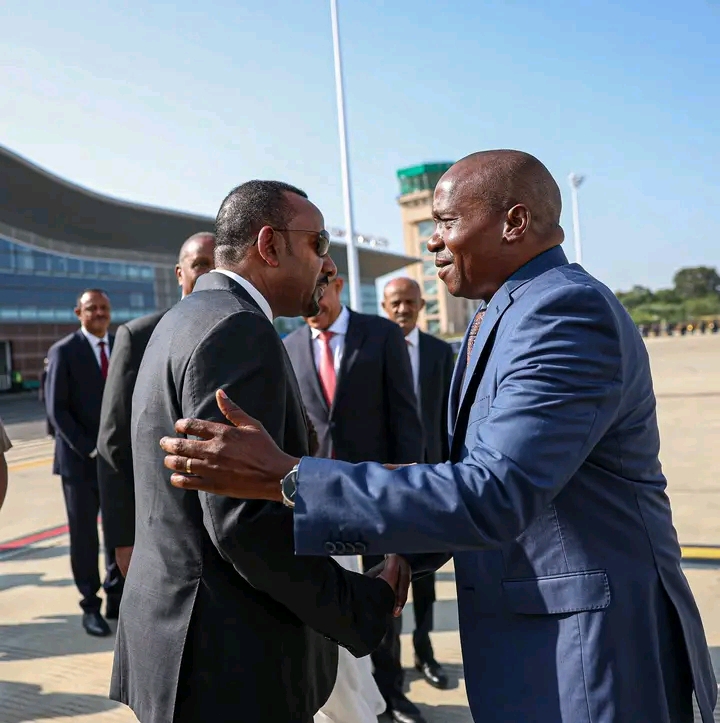
Ethiopian Prime Minister Welcomes Deputy President Kithure Kindiki to the 12th Tana High-Level Forum on Security in Africa
The welcome of Kenya's Deputy President Kithure Kindiki by Ethiopian Prime Minister Abiy Ahmed at the 12th Tana High-Level Forum on Security in Africa draws attention to the importance of diplomatic engagement among African leaders. Taking place in Bahir Dar from October 23 to 25, 2026, the forum focuses on “Pathways to Peace in Africa: Economic Sovereignty and Geopolitical Transformation.” It brings the relationship between security, economic development and African-led solutions into focus at a time when countries face increasingly interconnected challenges.
The 12th Tana High-Level Forum on Security in Africa is bringing together African leaders, policymakers, researchers and security experts to discuss the continent's most pressing peace and security challenges. The 2026 forum is scheduled for October 23–25 in Bahir Dar, Ethiopia, under the theme “Pathways to Peace in Africa: Economic Sovereignty and Geopolitical Transformation.”
The reported welcome extended to Kenya's Deputy President, Professor Kithure Kindiki, by Ethiopian Prime Minister Abiy Ahmed highlights the importance of diplomatic relations between Kenya and Ethiopia and the need for African countries to cooperate in addressing insecurity, political instability and economic challenges.Background of the Tana High-Level Forum
The Tana High-Level Forum on Security in Africa was established in 2012 as a platform for African-led discussions on peace, security and development. It was inspired by the African Union's 2009 Tripoli Declaration, which called for greater African ownership of efforts to resolve the continent's challenges. The forum is convened through the Institute for Peace and Security Studies at Addis Ababa University and the Tana Forum Secretariat.
Unlike formal diplomatic meetings that primarily focus on official government positions, the Tana Forum seeks to provide an open environment where leaders, academics, civil society representatives and other stakeholders can exchange ideas and examine difficult questions.Economic sovereignty refers to a country's ability to make informed decisions about its development, use its resources productively and establish economic partnerships that support its long-term interests.
Many African countries possess substantial natural resources, agricultural potential, youthful populations and expanding digital economies. Nevertheless, some continue to face challenges such as unemployment, limited industrial development, public debt pressures and dependence on imported products.
These challenges can affect governments' capacity to provide essential services, create employment and respond effectively to security threats.Security is among the most pressing issues confronting African governments. Different parts of the continent continue to experience armed conflict, terrorism, organised criminal activity, political instability and humanitarian emergencies.
In the Horn of Africa, insecurity can have consequences that extend beyond national borders. Conflict may force families to flee their homes, disrupt transport routes, weaken trade and place additional pressure on public services in neighbouring countries.
The region also faces challenges involving the movement of illegal weapons, trafficking networks and criminal groups that exploit weaknesses in border management.Kenya–Ethiopia relations and regional cooperation
Kenya and Ethiopia are neighbouring countries with interests in regional security, trade, infrastructure and economic development. Their geographical proximity makes cooperation important for addressing challenges that cannot be contained within national borders.
Diplomatic engagement provides an opportunity for both governments to maintain communication, address areas of concern and identify common interests.
Cooperation can cover border management, intelligence exchange where appropriate, trade facilitation, transport infrastructure and the prevention of cross-border criminal activity.Economic sovereignty and Africa's development
One of the most important questions raised by the 2026 forum is how Africa can turn its economic potential into inclusive prosperity.
The continent has abundant natural resources, fertile agricultural areas, mineral wealth and a growing population of young people. Yet economic opportunities remain uneven, and many communities continue to experience poverty and limited access to employment.
Economic sovereignty encourages countries to strengthen domestic production, improve the management of resources and develop industries that create value locally.
For example, processing agricultural products within African countries can generate more income than exporting raw commodities alone. Similarly, developing manufacturing, digital services and regional supply chains can create employment and reduce vulnerability to disruptions in international markets.The role of regional and continental institutions
African governments cannot address every security challenge independently. Regional and continental institutions provide mechanisms for consultation, mediation and coordinated action.
The African Union plays a central role in continental peace and security discussions, while regional organisations such as the Intergovernmental Authority on Development (IGAD) provide platforms for cooperation among countries in the Horn of Africa and surrounding areas.
These institutions can support diplomatic engagement, conflict prevention, early-warning systems and efforts to manage regional crises.Lasting peace requires the participation of more than political leaders and security agencies. Communities, women, young people, civil society organisations, academics and the private sector can all contribute to identifying the causes of conflict and developing solutions.
Communities often understand local tensions and grievances before they become larger security problems. Their involvement can help governments identify warning signs and design interventions that respond to people's actual needs.
Young people also need meaningful opportunities in education, employment and decision-making. When young people are excluded from economic and political life, frustration can grow and criminal groups may exploit their Vulnerabilities the 12th Tana Forum is designed to provide space for discussions on conflict prevention, economic sovereignty, regional integration and the changing geopolitical environment.
For Kenya, the event offers an opportunity to follow developments in continental security discussions and understand how African governments intend to address shared challenges.
The most important outcome will not simply be the presence of senior leaders. It will be whether discussions contribute to stronger partnerships, better policy coordination and practical measures that improve security and economic conditions.
Citizens should look for official announcements identifying any concrete commitments made during the gathering. These could include agreed areas of cooperation, new consultation mechanisms or policy proposals, if formally announced.

You Might Also Like
-
President William Ruto's October 24, 2026, visit to Mbiuni in Mwala Constituency placed water infrastructure at the centre of the government's development agenda for Ukambani. The commissioning of Phase Two of the Mwala Cluster Last Mile Water Supply Project is intended to improve access to water fo
-
Nairobi Governor Johnson Sakaja has called on the architect linked to the collapsed Eastleigh building to explain how construction proceeded without the required approvals. The incident has raised concerns about building safety, compliance with construction regulations and the effectiveness of inspe
-
Kirinyaga Governor Anne Waiguru has urged Mt. Kenya voters to prioritise development and reject opposition rhetoric as the country prepares for the 2027 General Election. Waiguru has called on residents to support President William Ruto’s re-election bid, emphasising the importance of infrastructu
-
The Directorate of Criminal Investigations (DCI) has arrested Festus Kipkirui, alias Festoo, in Mararianda, Narok East, over alleged online incitement linked to a Facebook page operating under the name Kipz Prince en Narok. The suspect was apprehended by a joint team of detectives from the DCI Headq
-
Seven people have been reported missing following the collapse of a multi-storey building under construction in Eastleigh, Nairobi. Rescue teams are continuing to search through the rubble for individuals feared trapped beneath the debris. The incident has raised concerns about construction safety,
-
President William Ruto is set to embark on a four-day development tour of the Ukambani region, covering Machakos, Kitui and Makueni counties. The visit is expected to focus on government projects, infrastructure development and initiatives aimed at improving the livelihoods of residents. The tour wi