GERMAN PRESIDENT FRANK-WALTER STEINMEIER ARRIVES IN KENYA FOR HIGH-LEVEL BILATERAL TALKS WITH PRESIDENT RUTO
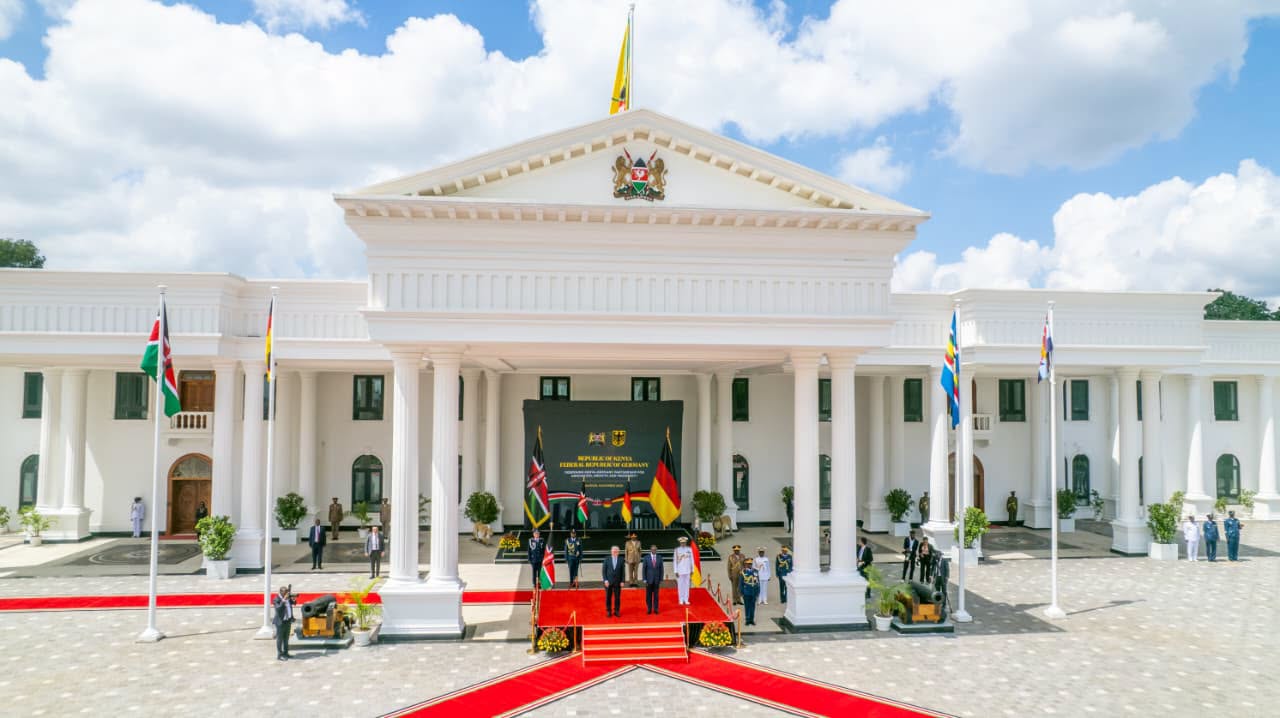
German President Frank-Walter Steinmeier has arrived at State House, Nairobi, for an official state visit and high-level bilateral talks with President William Ruto aimed at strengthening diplomatic and economic relations between Kenya and Germany. The discussions are expected to focus on expanding trade and investment, creating employment opportunities, promoting digital innovation, improving healthcare and strengthening cooperation in renewable energy, education and skills development. The visit also highlights the longstanding partnership between the two countries, with both leaders seeking to explore new opportunities for mutual development. Steinmeier's engagements include meetings with government officials, business representatives and visits to various Kenya-Germany cooperation projects. The visit is expected to further deepen bilateral ties and open new avenues for investment, technology transfer and economic growth.
German President Frank-Walter Steinmeier has arrived in Nairobi for an official state visit aimed at strengthening diplomatic relations and expanding economic cooperation between Kenya and Germany.
Steinmeier arrived at State House, Nairobi, on Wednesday, November 25, 2026, where he is scheduled to hold bilateral discussions with President William Ruto. The visit marks another important diplomatic engagement between the two countries, which have maintained longstanding relations built around trade, investment, development cooperation, education and international partnerships.
The German leader's visit is expected to provide an opportunity for the two governments to review their existing relationship, assess areas of mutual interest and explore additional opportunities for cooperation in sectors that support economic growth and development.
President Ruto is expected to use the engagement to strengthen Kenya's relationship with Germany, particularly in areas where European investment, technology, technical expertise and industrial partnerships could support the country's development priorities.
For Kenya, Germany remains an important European partner, with cooperation extending beyond traditional diplomatic relations to include economic development, vocational training, renewable energy, manufacturing, education and environmental conservation.
The discussions are also taking place against the backdrop of changing global economic conditions, increasing competition for investment and the need for countries to establish stronger international partnerships to address shared challenges.
The visit therefore provides an opportunity for Kenya and Germany to reaffirm their commitment to working together while identifying practical ways of expanding their cooperation.
The relationship between Kenya and Germany has continued to grow over the years, with both countries exploring opportunities to strengthen economic cooperation and expand their diplomatic engagement.
Germany is among Kenya's important European economic partners, with more than 100 German companies operating in the country. Some of these businesses also use Kenya as a regional base for their operations across East Africa.
The partnership has created opportunities in different sectors, including manufacturing, renewable energy, agriculture, technology, education and industrial development.
According to Germany's Federal Foreign Office, the two countries maintain close relations founded on cooperation and shared interests. Germany was also the first country to recognise Kenya under international law following its independence in 1963.
The arrival of Steinmeier is therefore expected to reinforce the historical relationship while opening additional opportunities for collaboration between the two governments.
One of the key areas expected to feature prominently during the discussions is trade and investment. Kenya has been seeking to attract more foreign investors to support industrialisation, increase exports, create employment and strengthen its position as a regional economic hub.
Germany, which has a strong industrial and technological base, could provide opportunities for partnerships that support Kenya's ambitions in manufacturing, agro-processing, infrastructure and renewable energy.
The two countries are also expected to explore ways of improving the business environment and encouraging more German companies to consider investing in Kenya.
Trade relations remain an important pillar of cooperation between Nairobi and Berlin, with both governments seeking to expand commercial exchanges and encourage private-sector participation.
Bilateral trade between Kenya and Germany increased by 23 per cent in 2025, reaching approximately €590 million, according to figures presented by Prime Cabinet Secretary Musalia Mudavadi during discussions with Germany's ambassador in October 2026.
The growth reflects the commercial opportunities available between the two countries and the potential for further expansion through increased investment and improved market access.
Kenya exports various agricultural products to international markets, while Germany remains an important source of industrial products, machinery, technology and other manufactured goods.
The government has been encouraging German investors to explore opportunities in sectors such as agro-processing, manufacturing, clean energy and infrastructure.
Increased investment in these areas could support local industries, promote value addition and create employment opportunities for Kenyans.
The presence of a German business delegation accompanying Steinmeier is particularly significant because it provides an opportunity for private-sector representatives to explore potential partnerships with Kenyan businesses and institutions.
The delegation is expected to engage with opportunities in the Kenyan market, while the presidential discussions provide a platform for addressing broader economic and diplomatic priorities.
The visit could also help strengthen business-to-business relationships and encourage the exchange of expertise between companies from the two countries.
Kenya, attracting more German investment could contribute to the government's efforts to expand industrial production and strengthen the country's competitiveness in international markets.
Beyond trade and investment, healthcare and digital transformation are expected to feature prominently during Steinmeier's engagements in Kenya.
The German President's programme includes visits to Kenya-Germany cooperation projects in healthcare and digital services, highlighting the importance both countries attach to technology-driven development and improved access to essential services.
One of the scheduled engagements is a visit to Tatu City, where Steinmeier is expected to tour a mobile healthcare initiative operated by Zuri Health.
The engagement is expected to showcase how technology and innovative healthcare delivery models can help improve access to medical services, particularly for communities that face challenges accessing conventional healthcare facilities.
Healthcare remains an important development priority for Kenya, with the government continuing to pursue reforms aimed at improving service delivery, expanding access to treatment and strengthening the country's health system.
Germany's experience in healthcare technology, medical research, professional training and health infrastructure could provide opportunities for further cooperation.
The visit is also expected to highlight the role of private-sector partnerships in developing solutions that respond to the changing healthcare needs of communities.
Another important engagement will involve digital services, with Steinmeier scheduled to visit Call Centre International Kenya, commonly known as CCI Kenya.
The company operates in the digital services and business process outsourcing sector, an industry that has increasingly attracted attention as Kenya seeks to position itself as a destination for technology-related investments.
The digital economy has become an important part of Kenya's development strategy, particularly because of its potential to create employment opportunities for young people.
Through digital services, business process outsourcing and technology-based enterprises, Kenya can expand its participation in international markets while providing opportunities for skilled workers.
Cooperation with Germany could also support knowledge exchange, digital innovation and the development of a workforce capable of competing in an increasingly technology-driven global economy.
Skills development is another area expected to receive attention during the German President's visit.
Steinmeier is scheduled to visit CareerBox, a non-profit organisation involved in training and skills development.
The engagement is expected to highlight the importance of equipping young people with practical skills that respond to the needs of employers and emerging industries.
Kenya continues to face the challenge of creating sufficient employment opportunities for its growing youthful population. As a result, vocational education, technical training and professional development remain important components of the country's economic agenda.
Germany has extensive experience in technical and vocational education, particularly through its dual training system, which combines classroom instruction with practical workplace experience.
This approach has helped develop a skilled workforce in different industrial and technical sectors.
Kenya could benefit from increased cooperation in vocational training, apprenticeships, professional certification and the exchange of technical expertise.
The two countries have also been working on skills mobility, with the aim of creating opportunities for qualified Kenyans to access legitimate employment and training opportunities in Germany.
In October 2026, Kenya's Foreign Affairs Cabinet Secretary Musalia Mudavadi discussed skills mobility with German Ambassador Sebastian Groth, including the implementation of existing agreements between the two countries.
Such cooperation could provide opportunities for qualified professionals while strengthening the exchange of knowledge and experience between Kenya and Germany.
However, both governments are expected to emphasise the importance of ensuring that migration opportunities are properly managed and that workers receive appropriate protection.
The German President's programme will also include engagements in arts, culture and environmental conservation, demonstrating that the relationship between the two countries extends beyond traditional economic and diplomatic activities.
Steinmeier is scheduled to visit Anno's One Fine Day Art Centre, an institution that provides artistic and cultural programmes for children and young people.
The engagement is expected to highlight the role of creative industries in promoting cultural exchange, nurturing talent and providing opportunities for young people to express themselves through artistic activities.
Arts and culture remain important areas of international cooperation because they provide opportunities for communities to learn about different traditions, histories and ways of life.
Through cultural partnerships, Kenya and Germany can strengthen people-to-people relations while supporting creative talent and artistic development.
Environmental conservation will also feature in the visiting President's programme.
On Thursday, November 26, Steinmeier is expected to travel to Naivasha, where he will visit the Crescent Island nature reserve on Lake Naivasha.
The engagement will highlight the importance of biodiversity conservation and the protection of natural ecosystems.
Kenya is home to important wildlife habitats and natural resources that support tourism, agriculture and other economic activities.
Environmental conservation is therefore a major priority, particularly as countries confront challenges associated with climate change, habitat destruction and biodiversity loss.
Germany has maintained cooperation with Kenya in environmental protection, climate action and sustainable development.
The two countries have a shared interest in promoting initiatives that support environmental sustainability while ensuring that economic development does not undermine the natural resources on which communities depend.
The relationship between Kenya and Germany dates back to the early years of Kenya's independence.
Germany was the first country to recognise Kenya under international law after independence in 1963, marking the beginning of a diplomatic partnership that has developed over several decades.
Since then, the two countries have maintained cooperation in education, trade, development assistance, technology, environmental protection and international affairs.
Their partnership has also involved engagements on regional peace and security, with both countries recognising the importance of stability in East Africa and the wider African continent.
In recent years, the relationship has expanded to include discussions on migration, clean energy, digital innovation and industrial development.
In September 2024, Kenya and Germany agreed on a Comprehensive Migration and Mobility Partnership covering educational and employment migration as well as cooperation on repatriation arrangements.
The latest presidential visit is expected to provide an opportunity to review progress in these areas and identify additional opportunities for cooperation.
Kenya is among the countries included in Steinmeier's five-day African tour, which also features visits to Côte d'Ivoire and Ghana.
The tour provides an opportunity for Germany to strengthen its engagement with African countries and explore economic and diplomatic partnerships across the continent.
His visit to Kenya comes as African countries increasingly seek international partnerships that can support industrialisation, infrastructure development, technology transfer and employment creation.
For Germany, stronger engagement with African economies provides opportunities to expand commercial relations, develop new partnerships and strengthen cooperation on shared global challenges.
Steinmeier's engagements in Kenya are expected to demonstrate Germany's interest in maintaining strong relations with the country while identifying practical areas where cooperation can deliver mutual benefits.
The German leader is also expected to meet representatives of Kenyan civil society during his engagements in Naivasha before concluding his visit.
For President William Ruto's administration, the visit presents an opportunity to strengthen Kenya's international partnerships and attract additional investment into priority sectors of the economy.
Kenya has continued to position itself as a regional business and investment destination, relying on its strategic location, skilled workforce, expanding digital economy and access to regional markets.
Stronger relations with Germany could help advance these ambitions through increased trade, technology partnerships, vocational training and investment in productive sectors.
The presence of German business representatives accompanying Steinmeier also provides an opportunity to connect diplomatic discussions with practical commercial interests.
However, the success of the engagement will ultimately depend on how the commitments and discussions translate into actual projects, investment opportunities and development programmes.
Both countries will need to maintain close cooperation to ensure that agreements reached during diplomatic engagements are implemented and deliver tangible benefits to their citizens.
As the two presidents meet at State House, attention will therefore be focused on the opportunities available to strengthen trade, deepen economic cooperation and expand Kenya's relationship with one of Europe's leading economies.
The visit is expected to reinforce the longstanding partnership between Nairobi and Berlin while opening new avenues for cooperation in healthcare, digital technology, skills development, environmental conservation and investment.
Kenya, the broader objective remains attracting international partnerships that can support economic transformation, create employment opportunities and strengthen the country's position in the global economy.

You Might Also Like
-
The Kenya National Highways Authority (KeNHA) has announced temporary traffic disruptions at the Lower Kabete–Ndumbuini–Kapenguria–Uthiru Road Interchange from November 26 to December 31, 2026, to facilitate reconstruction works on ramps, loops and slip roads. The planned works are expected to
-
South African President Cyril Ramaphosa has secured a significant legal victory after the Western Cape High Court overturned a parliamentary panel report linking him to the controversial theft of $580,000 (approximately KSh75.5 million) from his Phala Phala game farm in 2020. The court declared the
-
Veteran Nigerian actor Pete Edochie has passed away at the age of 79 following a prolonged battle with prostate cancer. His family confirmed that the legendary Nollywood star died at 12:30 a.m. on Wednesday, November 25, 2026, in Enugu, Nigeria. Born on March 7, 1947, in Zaria, Kaduna State, Edochie
-
Roads and Transport Cabinet Secretary Davis Chirchir has raised concerns over a KSh255 billion funding shortfall facing the State Department for Roads in the 2027/28 financial year. Speaking before the National Assembly Transport Committee, Chirchir warned that failure by the National Treasury to br
-
One person has been confirmed dead, while four others sustained injuries following a horrific head-on collision involving two trucks along the Nairobi-Mombasa Highway in Makueni County. The accident occurred at a location known as Crasher, between Kiboko and Masimba. The circumstances leading to the
-
The regional organisation wants Kenya to conduct free, fair and peaceful elections while restoring public confidence in the electoral process, particularly among young people. Its message comes at a time when IEBC is facing pressure over voter registration, election technology, procurement, funding