Kenya Boosts Ebola Fight as India Donates KSh 83.39 Million in Supplies, IOM Adds KSh 2.98 Million
Kenya's receipt of Ebola response supplies valued at KSh 83.39 million from India marks an important addition to the resources available to the Ministry of Health as the country responds to Bundibugyo Ebola virus disease. The consignment includes thousands of protective kits, respirators, N95 masks and more than 86,000 sample transport kits to support frontline health workers, laboratories and emergency response teams. The reported KSh 2.98 million contribution from IOM adds to the broader picture of international assistance, although the specific details of that donation require confirmation from an official source. Ultimately, the success of Kenya's response will depend on more than the value of donations. Timely distribution, adequate staffing, effective contact tracing, reliable laboratory testing, safe treatment facilities and public cooperation will all be essential in limiting transmission and protecting lives. The Ministry of Health and its partners will need to sustain these efforts while keeping the public informed through accurate, timely and transparent communication.
Kenya has strengthened it's response to Ebola following the receipt of emergency medical supplies worth KSh 83,390,710 from the Government of India, as international partners continue supporting the Ministry of Health in its efforts to contain the spread of the disease. The latest assistance comes at a critical time as health authorities intensify disease surveillance, contact tracing, laboratory testing and infection prevention measures following confirmed cases of Bundibugyo Ebola virus disease in the country.
The International Organization for Migration (IOM) has also been reported to have contributed Ebola response supplies worth approximately KSh 2.98 million, adding to the resources available for emergency preparedness and disease control. Together, these contributions highlight the importance of international cooperation, adequate medical equipment and coordinated action in protecting healthcare workers and communities from the threat posed by Ebola.India Hands Over KSh 83.39 Million in Ebola Response Supplies
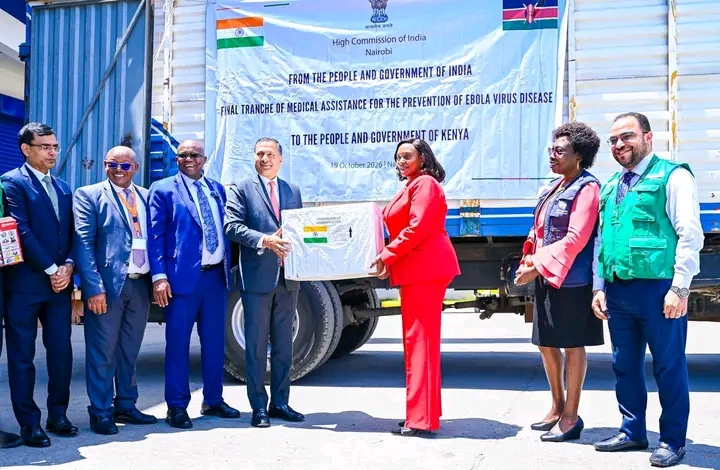
The handover took place on Monday, October 19, 2026, at the Kenya Medical Supplies Authority (KEMSA) facility in Embakasi, Nairobi. India's High Commissioner to Kenya, Dr Adarsh Swaika, handed over the consignment to Public Health and Professional Standards Principal Secretary Mary Muthoni.
The supplies, valued at KSh 83,390,710, are intended to improve Kenya's preparedness and strengthen the response to the ongoing Bundibugyo Ebola situation. The Ministry of Health has emphasised that adequate protective equipment and timely medical interventions are essential in preventing further transmission and protecting healthcare workers.6,000 personal protective equipment (PPE) kits.
60 powered air-purifying respirators.
30,000 N95 protective masks.
More than 86,000 sample transport kits.
Medical gowns, gloves, face shields and protective boots.
Infrared thermometers and other emergency response materials.
These supplies are expected to support health workers attending to suspected and confirmed patients, rapid response teams, isolation and treatment facilities, laboratories and screening operations at points of entry.
The sample transport kits are particularly important because laboratory confirmation depends on the safe collection, packaging and transportation of specimens. Proper handling helps protect healthcare personnel and laboratory workers from accidental exposure while enabling authorities to establish whether suspected cases are infected.The reported donation by the International Organization for Migration, commonly known as IOM, worth approximately KSh 2.98 million, represents another contribution to Kenya's emergency response efforts.
IOM is a United Nations-related international organisation that works on migration, humanitarian assistance and health-related challenges affecting mobile populations. Its involvement in public health emergencies can be particularly relevant where disease surveillance, cross-border movement and access to vulnerable communities are concerns.According to reports published on October 18, 2026, Kenya had recorded eight confirmed cases, including one death. The cases were linked to the initial patient, who had travelled from the Democratic Republic of Congo before becoming ill in Kenya. Health authorities had also identified contacts and placed exposed individuals under quarantine and monitoring.
The growing number of confirmed infections has increased the importance of rapid diagnosis, safe patient management and close monitoring of people who may have been exposed to the virus.
Ebola response operations require more than treatment facilities. They also depend on reliable protective equipment, trained health workers, functioning laboratories, effective surveillance and communication with communities.Supporting isolation and treatment facilities
Facilities managing suspected or confirmed Ebola cases must maintain strict infection prevention procedures. This includes separating patients where necessary, providing appropriate protective equipment and ensuring that contaminated materials are safely handled.
The donated supplies can help facilities maintain these safeguards and prepare for additional patients if required.
Adequate supplies are also important for ensuring that healthcare workers can continue providing other essential services without unnecessarily increasing the risk of infection.Government Intensifies Surveillance and Contact Tracing
The Ministry of Health has continued coordinating the national response through surveillance, laboratory testing, contact tracing and infection prevention measures.
Contact tracing involves identifying people who may have been exposed to an infected individual, assessing their level of risk and monitoring them for symptoms during the relevant observation period.
This process is critical because people who have been exposed may require monitoring before they develop symptoms. Identifying potential cases early allows health authorities to arrange testing and isolation when necessary.What Kenyans Need to Know About Bundibugyo Ebola
Bundibugyo Ebola is a disease caused by the Bundibugyo virus, one of the viruses responsible for Ebola disease. It can cause severe illness and requires specialised infection prevention and clinical management measures.
Symptoms may include fever, fatigue, muscle pain, headache, weakness, vomiting, diarrhoea and, in some cases, bleeding. These symptoms can overlap with those of other illnesses, so symptoms alone cannot confirm Ebola.International Partnerships Strengthen Health Security
India's donation and the reported IOM contribution illustrate the importance of international cooperation during public health emergencies.
Disease outbreaks can place considerable pressure on national health budgets, supply chains and staffing arrangements. International partners can help bridge resource gaps by providing medical commodities, technical expertise, funding and logistical support.
The World Health Organization has also supported Kenya's response with essential medical supplies intended to protect frontline workers and facilitate the testing of suspected cases. Distribution and Accountability Will Be Critical
As additional supplies arrive, the Ministry of Health faces the task of ensuring that they reach the areas where they are most urgently needed.
This includes hospitals managing suspected cases, designated isolation facilities, laboratory teams, rapid response units and personnel conducting screening and surveillance.
The distribution process should consider existing stock levels, the number of health workers requiring protection, the workload of individual facilities and the expected demand for testing materials.

You Might Also Like
-
Self-proclaimed preacher Paul Mackenzie and 29 co-accused have been found guilty on all 191 murder counts in the Shakahola case, marking a major development in one of Kenya’s most disturbing criminal investigations. The case is linked to the deaths of followers associated with Mackenzie’s Good N
-
President William Ruto has received the APSCA 2026 Continental Leadership Award for Visionary Governance and Human Capital Transformation, with Deputy Head of Public Service Amos Gathecha accepting the honour on his behalf. The recognition highlights the importance of leadership, effective governanc
-
Kenya is expected to experience varied weather conditions during this week's forecast period, with rainfall anticipated across western Kenya, the Lake Victoria Basin, the Rift Valley, Central Kenya, Nairobi and selected eastern and coastal areas. Thunderstorms are possible in some locations, while o
-
Siaya Governor James Orengo has condemned attacks and alleged propaganda directed at the Odinga family, describing them as a betrayal of the political struggles and sacrifices associated with the late former Prime Minister Raila Odinga. His remarks come amid growing political tensions over Raila’s
-
Over 6,000 widows meet in Kericho.Led by Governor Eric Mutai, Woman Representative Beatrice Kemei and Principal Secretary Ann Wangombe, the initiative brought attention to the need for sustainable programmes that enable widows to support their families and participate meaningfully in community devel
-
The decision by some farmers in Kapkoros, Bomet Central, to begin uprooting tea bushes has brought renewed attention to the challenges facing smallholder tea growers in Kenya. The reported KSh17-per-kilogramme bonus at Kapkoros for the 2025/2026 financial year has added to concerns about rising pro