President William Ruto Receives APSCA 2026 Continental Leadership Award for Visionary Governance and Human Capital Transformation
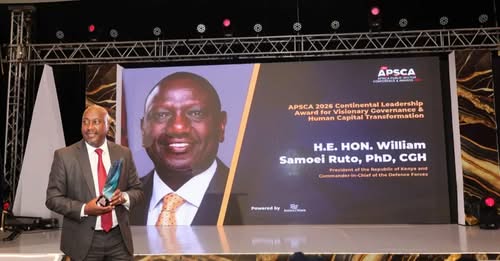
President William Ruto has received the APSCA 2026 Continental Leadership Award for Visionary Governance and Human Capital Transformation, with Deputy Head of Public Service Amos Gathecha accepting the honour on his behalf. The recognition highlights the importance of leadership, effective governance, institutional development and investment in human capital as key pillars of national progress. It also brings attention to the role of public institutions in implementing government policies, strengthening service delivery and creating opportunities for citizens. Human capital transformation remains an important part of Kenya’s development agenda, particularly in education, skills development, employment creation and improving the efficiency of the public service. The award places renewed focus on leadership and the responsibility of government institutions to translate development priorities into tangible outcomes that improve the lives of Kenyans.
President William Ruto has received the APSCA 2026 Continental Leadership Award for Visionary Governance and Human Capital Transformation, in recognition of the leadership themes highlighted by the continental honour. Deputy Head of Public Service Amos Gathecha received the award on the President’s behalf.
The recognition places a spotlight on governance, leadership and human capital development as important areas of discussion in Kenya’s public administration. It also provides an opportunity to reflect on the role of government leadership in shaping national priorities, strengthening public institutions and improving the delivery of services to citizens.
The award, presented in President Ruto’s name, highlights the importance attached to visionary governance and the development of human capital. These two areas are central to conversations about national development, economic transformation and the capacity of public institutions to respond to the needs of the population.
Amos Gathecha Receives Award on Behalf of President Ruto
Deputy Head of Public Service Amos Gathecha represented President William Ruto in receiving the APSCA 2026 Continental Leadership Award.
His role in receiving the recognition demonstrates the involvement of senior government officials in representing the Head of State at official engagements. Such representation is a regular feature of public administration, allowing government business and official functions to proceed even when the President is not personally present.
Gathecha’s acceptance of the award on behalf of the President also brought attention to the Office of the Deputy Head of Public Service and its place within the country's administrative structure.
The Public Service plays an important role in implementing government programmes, coordinating ministries and departments, and ensuring that policies are translated into practical action. Senior officials are therefore central to the functioning of government and the delivery of services across different sectors.
While the award was presented to President Ruto, its stated themes of governance and human capital transformation relate to broader questions about the effectiveness of public institutions and the contribution of government employees to national development.
Focus on Visionary Governance
Visionary governance is an important concept in public leadership. It involves setting clear national priorities, establishing development goals and creating strategies that guide institutions towards achieving those objectives.
For governments, effective leadership requires more than announcing policies. It also involves planning, coordination, accountability and the ability to implement programmes that respond to the needs of citizens.
In Kenya, governance remains closely connected to issues such as economic growth, employment creation, infrastructure development, healthcare, education and the cost of living. These matters affect households, businesses and communities across the country.
The recognition associated with the APSCA 2026 Continental Leadership Award brings these broader leadership questions into focus. It highlights the importance of having a clear development direction and ensuring that public institutions have the capacity to implement government priorities.
Good governance also depends on transparency and accountability. Citizens expect public resources to be managed responsibly and government decisions to be guided by the law, established procedures and the public interest.
Public confidence is strengthened when institutions communicate clearly, provide accessible services and demonstrate measurable progress in addressing challenges facing the population.
For this reason, awards associated with leadership and governance can also serve as a starting point for conversations about the standards expected of public officials and the responsibilities that come with holding public office.
Ultimately, the impact of any governance approach is assessed not only through formal recognition but also through its implementation and the outcomes experienced by citizens.
Human Capital Transformation as a Development Priority
Human capital transformation is another central theme of the award. It refers broadly to developing people's knowledge, skills, abilities and productivity so that they can contribute more effectively to economic and social progress.
A country's development depends significantly on the capabilities of its population. Education, professional training, healthcare, innovation and access to employment opportunities all influence the ability of individuals to participate in national growth.
For Kenya, investing in human capital remains relevant to efforts to address unemployment, improve productivity and prepare young people for opportunities in an increasingly competitive economy.
The country has a large youth population, making skills development and employment creation important subjects in national policy discussions. Young people require opportunities to acquire practical skills, gain work experience and participate in sectors capable of supporting sustainable livelihoods.
Human capital development also extends beyond young people entering the labour market. It includes strengthening the skills of public servants, supporting professional development and ensuring that workers can adapt to changing technologies and economic conditions.
Within government, a capable public service is essential for translating policy decisions into results. Officials require appropriate training, professional standards, resources and effective management systems to perform their duties efficiently.
The theme of human capital transformation therefore connects leadership at the national level with the everyday experiences of workers, students, entrepreneurs and communities.
It also raises questions about how governments can ensure that investments in education, training and public service development produce practical benefits for the wider population.
Leadership and the Role of Public Institutions
Public institutions are important to the success of national development programmes. They provide the administrative structures through which government policies are implemented, public funds are managed and services are delivered.
Effective leadership can help institutions establish clear objectives, coordinate their activities and focus on results. However, institutional performance also depends on professional staff, adequate resources, accountability mechanisms and consistent implementation.
The recognition presented to President Ruto under the themes of visionary governance and human capital transformation highlights two areas that are closely linked to the functioning of public institutions.
Governance establishes the direction and priorities, while human capital development helps ensure that institutions have the people and skills required to carry out their responsibilities.
When these elements work together effectively, public institutions are better positioned to respond to the needs of citizens. Conversely, weaknesses in planning, coordination or implementation can make it difficult for even well-intentioned programmes to achieve their objectives.
For this reason, leadership recognition can be considered alongside the wider responsibilities of government to strengthen institutions, maintain accountability and improve service delivery.
In Kenya, these responsibilities extend across national and county governments, as well as public agencies and departments that serve different sections of the population.
Recognition and Public Accountability
The APSCA 2026 Continental Leadership Award provides a platform for discussing leadership and development priorities associated with President Ruto's administration.
However, the significance of a leadership award is best understood alongside the broader principles of public accountability. Recognition can draw attention to particular areas of leadership, but the implementation of policies and their measurable effects remain important considerations when assessing public administration.
Citizens evaluate government performance through many aspects of daily life, including access to healthcare, the quality of education, employment opportunities, infrastructure, public safety and the affordability of essential goods and services.
They also expect government institutions to use public resources responsibly and to provide clear explanations of their decisions.
These expectations apply to all public officials, regardless of the recognition they receive. Leadership involves both the authority to make decisions and the responsibility to ensure that those decisions serve the public interest.
For the government, continued engagement with citizens, effective implementation of development programmes and transparent management of resources remain important elements of maintaining public confidence.
The award's focus on governance and human capital transformation consequently offers a broader framework for discussing the relationship between leadership, institutional performance and national development.
A Broader Conversation on Kenya's Development
Kenya's development ambitions depend on several interconnected factors, including economic stability, investment, infrastructure, education, healthcare and the effective use of human resources.
Leadership plays a role in determining how these priorities are organised and pursued. At the same time, achieving meaningful progress requires cooperation among government institutions, the private sector, civil society and citizens.
Human capital development is particularly important because it influences the ability of people to participate in and benefit from economic opportunities. Skilled workers, effective public servants and innovative entrepreneurs can contribute to stronger institutions and more productive economic activity.
Similarly, visionary governance requires development plans to be supported by realistic implementation strategies, clear responsibilities and systems for monitoring progress.
The recognition awarded to President Ruto brings these themes into focus at a time when questions about leadership, economic opportunities and public service delivery remain significant in Kenya's national conversation.
The challenge for any administration is to translate its stated priorities into outcomes that citizens can experience in their daily lives.
Such outcomes may include better access to essential services, improved public administration, opportunities for young people and the creation of conditions that allow businesses and communities to thrive.
These objectives require sustained attention, institutional cooperation and accountability throughout the implementation process.
President William Ruto has received the APSCA 2026 Continental Leadership Award for Visionary Governance and Human Capital Transformation, with Deputy Head of Public Service Amos Gathecha accepting the honour on his behalf.
The award highlights governance and human capital development as important themes in discussions about leadership and national progress. It also draws attention to the responsibilities of public institutions in implementing policies, developing professional capacity and delivering services to citizens.
As Kenya continues to pursue its development priorities, the relationship between effective leadership, skilled human resources and accountable institutions remains an important subject of public interest.
The broader measure of leadership will continue to include how policies are implemented, how public resources are managed and how government programmes affect the lives of ordinary Kenyans.
The recognition therefore provides an occasion to reflect on the importance of governance and human capital transformation in shaping the country's development ambitions and the role that public institutions play in pursuing them.

You Might Also Like
-
Self-proclaimed preacher Paul Mackenzie and 29 co-accused have been found guilty on all 191 murder counts in the Shakahola case, marking a major development in one of Kenya’s most disturbing criminal investigations. The case is linked to the deaths of followers associated with Mackenzie’s Good N
-
Kenya is expected to experience varied weather conditions during this week's forecast period, with rainfall anticipated across western Kenya, the Lake Victoria Basin, the Rift Valley, Central Kenya, Nairobi and selected eastern and coastal areas. Thunderstorms are possible in some locations, while o
-
Siaya Governor James Orengo has condemned attacks and alleged propaganda directed at the Odinga family, describing them as a betrayal of the political struggles and sacrifices associated with the late former Prime Minister Raila Odinga. His remarks come amid growing political tensions over Raila’s
-
Over 6,000 widows meet in Kericho.Led by Governor Eric Mutai, Woman Representative Beatrice Kemei and Principal Secretary Ann Wangombe, the initiative brought attention to the need for sustainable programmes that enable widows to support their families and participate meaningfully in community devel
-
The decision by some farmers in Kapkoros, Bomet Central, to begin uprooting tea bushes has brought renewed attention to the challenges facing smallholder tea growers in Kenya. The reported KSh17-per-kilogramme bonus at Kapkoros for the 2025/2026 financial year has added to concerns about rising pro
-
Democracy for the Citizens Party (DCP) leaders have accused President William Ruto’s administration of deliberately frustrating counties perceived to support the opposition, raising concerns over equitable resource allocation, development projects and service delivery. The leaders insist that poli