



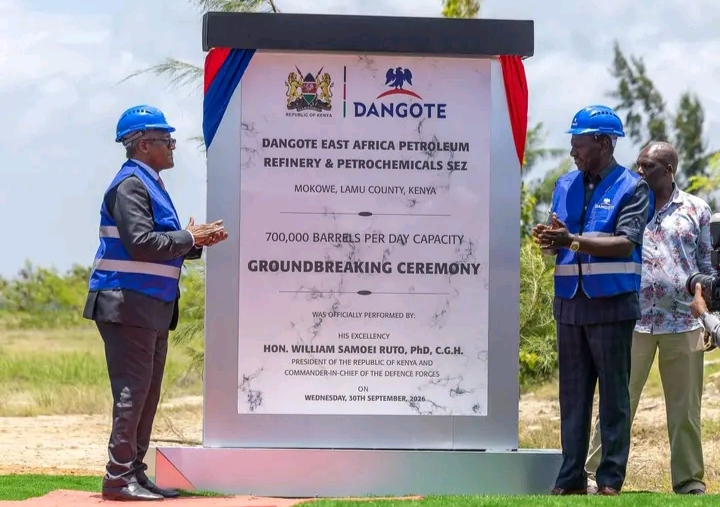
RUTO LAUNCHES SH2.2 TRILLION DANGOTE OIL REFINERY IN LAMU: A NEW ENERGY GIANT RISES IN KENYA
President William Ruto's September 30, 2026 groundbreaking ceremony with Aliko Dangote marks a major new chapter in Kenya's energy and industrial development. The proposed Sh2.2 trillion, 700,000-barrel-per-day Dangote East Africa Petroleum Refinery is expected to supply petroleum products to Kenya and neighbouring countries, create employment, attract investment and strengthen the country's position as a regional energy hub. At the same time, the project faces important issues involving land, environmental protection, infrastructure, financing and crude-oil supply. Its eventual impact will depend on how successfully those issues are addressed as construction moves forward toward the targeted 2030 completion.
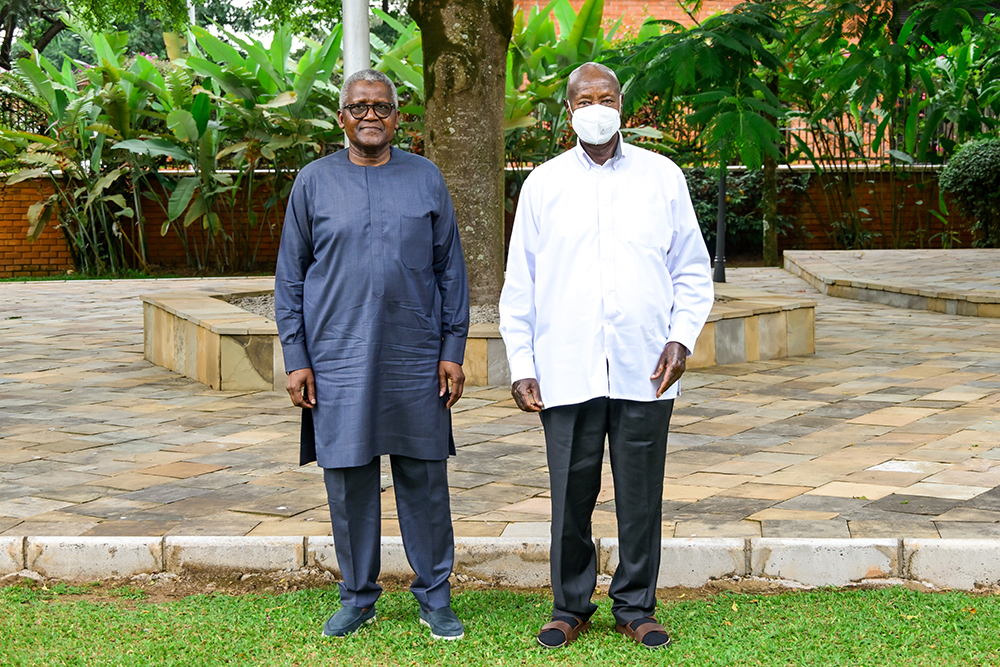
President William Ruto and Nigerian businessman Aliko Dangote have officially broken ground for the construction of the Dangote East Africa Petroleum Refinery in Lamu County, marking the formal beginning of one of the largest industrial and energy investments in Kenya and the wider East African region.
The groundbreaking ceremony took place on Wednesday, September 30, 2026, bringing together President Ruto, Deputy President Kithure Kindiki, Dangote and several African leaders and senior government officials. The project, valued at about $16 billion, equivalent to approximately Sh2.2 trillion, is expected to transform Kenya's petroleum industry and strengthen the region's ability to process crude oil locally.
Ruto and Dangote mark the beginning of construction
The event in Lamu represents the transition of the refinery project from plans and preparations to actual construction. President Ruto joined Dangote at the groundbreaking ceremony, with heavy machinery already positioned at the project site near Lamu Port.
The refinery is planned to have a processing capacity of 700,000 barrels of crude oil per day when fully operational. This would make it one of the largest refinery projects planned in Africa and give Kenya a major new role in the regional petroleum supply chain.
The project is expected to supply refined petroleum products to Kenya and other markets across East and Central Africa. These products are expected to include petrol, diesel, aviation fuel, LPG, kerosene, heavy fuel oil and bitumen.
President Ruto has repeatedly presented the refinery as an important investment for reducing dependence on imported refined petroleum products and increasing Kenya's industrial capacity.
A major investment for Lamu
The refinery is planned for the Lamu area, close to the country's expanding port infrastructure. Its location is significant because Lamu Port is part of the wider LAPSSET corridor, which is intended to connect Kenya with neighbouring countries through ports, roads, pipelines and other infrastructure.
The government expects the refinery to contribute to the development of an industrial centre around Lamu and create opportunities in transportation, logistics, manufacturing, construction and other supporting industries.
Reuters reported that the project could create more than 50,000 jobs, while other reports have cited a higher figure of about 60,000 jobs associated with the project. These figures include employment opportunities expected directly and indirectly from construction and related economic activities.
For Lamu residents, the project therefore has the potential to change the county's economic landscape by attracting workers, contractors, suppliers and other businesses.
Why the refinery is important to Kenya
Kenya currently relies heavily on imported refined petroleum products to meet domestic demand. The proposed refinery is intended to change part of that arrangement by allowing crude oil to be processed within the region.
According to information published by Daily Nation, East Africa's petroleum demand is estimated at roughly 450,000 barrels per day, while Kenya and regional markets served through Kenyan oil marketing companies consume about 21 million litres of petrol, diesel and jet fuel per day.
A refinery operating at its planned 700,000-barrel-per-day capacity would therefore be considerably larger than Kenya's domestic requirements. The intention is for surplus refined products to be supplied to neighbouring countries.
This could position Kenya as an important regional petroleum-processing and distribution centre.
What 700,000 barrels per day means
The 700,000-barrel figure does not mean the refinery will produce 700,000 barrels of petrol every day.
Rather, it represents the amount of crude oil feedstock the refinery is designed to process daily at full capacity. One standard oil barrel contains approximately 159 litres. At 700,000 barrels per day, the refinery would therefore process more than 111 million litres of crude oil per day at full capacity.
Through different refining processes, the crude would be converted into various petroleum products.
The refinery's expected output could include fuels used by motorists, airlines, industries, construction companies and households. Its products would also potentially support Kenya's transport, manufacturing, agricultural and construction sectors.
Where will the crude oil come from?
One of the important questions surrounding the refinery is the supply of crude oil.
Kenya has oil resources in the South Lokichar Basin in Turkana County, and production from the fields is expected to begin in the future. According to Daily Nation, the Turkana crude could supply part of the refinery's requirements, while additional crude would have to come from regional and international sources.
This means the refinery is being planned as a regional facility rather than one dependent entirely on Kenyan crude.
Its location near the coast provides access to imported crude and other petroleum-related supplies through maritime transport.
Connection to Lamu Port and LAPSSET
The location of the refinery is also linked to the development of Lamu Port and the wider LAPSSET infrastructure.
Lamu Port is expected to serve as an important entry and exit point for crude oil, petroleum products and other industrial cargo. Finished products from the refinery could eventually be transported through pipelines, roads, marine facilities and other transport systems.
The integration of the refinery with the wider transport corridor could therefore make Lamu an important logistics and energy centre for East Africa.
The project also fits into the government's broader objective of using infrastructure development to attract private investment and encourage industrialisation outside Nairobi and other traditional economic centres.
Expected economic benefits
The refinery is expected to generate economic activity at several levels.
During construction, thousands of workers and contractors could be involved in engineering, civil works, transportation, security, construction and supply services.
Once operational, the refinery would require engineers, technicians, drivers, security personnel, logistics specialists and other professionals.
Local businesses could also benefit by supplying food, accommodation, transportation, equipment, construction materials and other services.
The project could further generate demand for roads, electricity, water, housing and other infrastructure around Lamu.
At the national level, the government expects the investment to attract foreign capital and strengthen Kenya's position as a regional investment destination.
Potential impact on fuel security
One of the major arguments for the refinery is energy security.
Kenya's economy depends heavily on petroleum products for transportation, aviation, manufacturing, agriculture and other activities. Disruptions in international oil markets can therefore affect fuel prices and the wider economy.
A large regional refinery could provide an additional source of refined products within East Africa.
It could also reduce the distance between petroleum production and regional consumers and potentially make the supply chain more resilient to international disruptions.
However, the actual effect on fuel prices will depend on several factors, including crude oil prices, refining costs, financing, transportation expenses, taxes, exchange rates and regional demand.
Dangote's experience in Nigeria
The Lamu project is closely associated with Dangote's refinery in Nigeria.
The Nigerian Dangote refinery was designed with a capacity of 700,000 barrels per day, the same headline capacity planned for the Lamu facility. The experience from Nigeria is therefore being used as part of the rationale for developing a similarly large refinery in East Africa.
Dangote has described the project as part of a broader effort to encourage African countries to process more of their own raw materials rather than exporting crude and importing finished petroleum products.
The Lamu refinery would consequently represent a major expansion of Dangote's presence in Africa's energy and industrial sector.
Job creation and opportunities for young people
Employment is likely to be one of the most closely watched aspects of the project.
The construction phase will require large numbers of workers, while the completed facility will need specialised technical staff.
The project could also create opportunities beyond direct employment. Kenyan companies may participate through construction contracts, transportation, catering, security, engineering, maintenance and other services.
For young people in Lamu and other parts of Kenya, the project could increase demand for technical and vocational skills.
This could encourage training in areas such as electrical engineering, mechanical engineering, welding, instrumentation, logistics and industrial safety.
Environmental and land concerns
Despite the scale of the investment, the project has also faced concerns relating to land rights, environmental protection and the interests of communities living around the proposed site.
The groundbreaking comes amid legal challenges involving the project site. Reuters reported on September 29 that Dangote said the refinery groundbreaking would proceed despite a Kenyan court ruling concerning a land-rights dispute, although the legal situation could affect some site activities.
Environmental concerns have also been raised because Lamu contains ecologically and historically important areas, including the Lamu Old Town World Heritage area.
These concerns mean that construction and eventual operation will be closely watched by communities, environmental groups and government agencies.
The project's economic benefits will therefore need to be balanced with legal requirements, environmental safeguards and the interests of affected communities.
Regional significance
The refinery is not designed only for Kenya.
Its planned capacity is much larger than Kenya's domestic petroleum requirements, meaning the business model depends significantly on regional and international markets.
Countries in East and Central Africa could become important markets for its products.
This could strengthen Kenya's role as a regional energy and logistics hub, particularly because the country already has established petroleum storage, transportation and distribution infrastructure.
The road ahead
The groundbreaking does not mean the refinery is already operational. It marks the beginning of the construction phase.
Reuters reported that the project is targeted for completion in 2030, meaning several years of construction, equipment installation, testing and commissioning will be required before full-scale refining begins.
The success of the project will depend on construction progress, financing, crude supply, infrastructure, environmental compliance and the resolution of legal and community concerns.
President Ruto has also urged the investor to maintain the project's construction timeline, while the government has pledged support for the investment

You Might Also Like
-
President William Ruto says Kenya will take a stake in the proposed Dangote East Africa Refinery and contribute its assets to the project, stressing that the country will invest and not expect anything for free.
-
Ugandan President Yoweri Museveni has praised Aliko Dangote as an African investor committed to developing the continent, while criticising leaders he says prioritise foreign interests over African development.
-
Prime Minister Abiy Ahmed's message during the Dangote East Africa Petroleum Refinery groundbreaking was centred on energy security, Ethiopia's access to additional fuel supplies, regional trade, industrialisation, investment and opportunities for young Africans. He described the Lamu refinery as a
-
Former Nigerian President Olusegun Obasanjo's attendance at the September 30, 2026 groundbreaking of the Dangote East Africa Petroleum Refinery in Lamu added historical and continental significance to the ceremony. His presence alongside President William Ruto, Aliko Dangote and other African leader
-
The EPRA report released on September 29 provides a broad assessment of Kenya's energy and petroleum sectors for the year ended June 30, 2026. Its findings show record electricity demand, increased generation, continued dominance of renewable energy, rising household electricity consumption, higher
-
Aliko Dangote says he is not intimidated by court challenges, maintaining that his team is ready to defend the proposed KSh2.2 trillion Lamu refinery through legal channels.